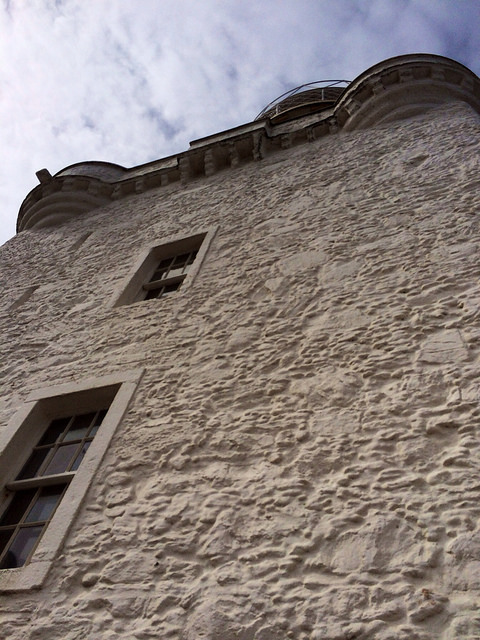
Yes, Fraserburgh boasts its very own lighthouse in a castle! The 16th century Kinnaird Castle, on the left, was converted into a lighthouse in 1787 and is now part of the Museum of Scottish Lighthouses. On the right is the modern automated lighthouse.
Before we go in, let’s walk on a bit to the wine tower, the oldest building in Fraserburgh. The photo may not be the best of the tower, but look at that sky!
The Love Story
The wine tower is thought to have been a secret post-reformation Catholic Chapel, and has a sad love story attached to it. Strain your eyes and you can just see the red paint on the ground there in the picture above.
Gight Castle may be one of the lesser known castles of Aberdeenshire, but it has a rich, if somewhat bleak, history with many of its owners dying prematurely. Built in the 15th century by the Gordon family, it’s the ancestral home of Lord Byron. A ghostly piper is said to haunt the ruins. The nearby Hagberry Pot in the River Ythan is said to be bottomless and full of treasure!
Walking Around Gight Castle
The quines took a walk. We started in Methlick and strolled through the Braes of Gight woods, across fields and along roads. This was the long way to do it: there is a car park relatively near to the castle. First view:
The castle was surrounded by barbed wire and there were ‘enter at your own risk’ signs.
In we went:
Great windows:
We were careful not to wake Sleeping Beauty. Or the ghostly piper.
I was most impressed by this brave little tree:
Hagberry Pot
Then, taking the circular route, we headed off down to the river and tried to work out which bit was the Hagberry Pot. Nowhere looked very bottomless or a good hiding place for jewels, but this seemed the most likely site by the bridge:
The 7th Laird of Gight threw his jewels in there when the castle was sacked by the Covenanters. The poor diver who was sent down to retrieve them floated back up to the top in four pieces. There is a more involved version of this story here, featuring the devil. We did not go in.
The walk back along the river was pleasant, if a bit boggy, with glimpses of the Castle up on the hill.
Newsletter
Sign up to the mailing list for news about my life and writing, a free story and some exclusive photos. If you would like to hear about new books and offers, you can follow my Amazon author page.
SISTERS AT THE EDGE OF THE WORLD
Set in 1st century Scotland, SISTERS AT THE EDGE OF THE WORLD includes the battle of Mons Graupius between the Romans and the Caledonian tribes. The book features a neurodivergent main character and some rather complicated romance…
Taking place mainly in a fictional castle, THE MERMAID AND THE BEAR blends an often overlooked period of history, the Scottish witchcraft accusations, in particular the 1597 Aberdeen witchcraft panic, with a love story. There’s 6 chapters of medieval Christmas too.
FIREFLIES AND CHOCOLATE was inspired by the 600 children and young people who were kidnapped from Aberdeen during the 1740s and sold into indentured servitude in the American Colonies. The story follows the adventures of Elizabeth Manteith from the castle and her determined efforts to get back home. There’s love. There’s proper derring-dos on the high seas… and there’s chocolate!
Deer Abbey in Aberdeenshire is a beautiful sprawling ruin. It’s a peaceful place to visit. Reflective. A place to peer through old doorways into the past.
Into the kitchen…
The Man Trap
If I look back into my own past, I see myself in quite a state, just about to go into hospital and become monstrous. I am better this year. Better than that anyway. Able to go out and about to places other than my doctor’s surgery.
Which brings me to the man trap:
Man trap!
You would definitely need some medical intervention after stepping in that! It’s a hideous contraption that was designed to catch poachers, widely used in the 19th century by local Lairds. It’s not known how it came to be at Deer Abbey.
From one of the informational plaques, the man trap in use:
Ouch!
History of the Abbey
For 340 years, the Abbey housed a Cistercian community. The monks of Deer wore white robes and no underwear, a brave choice given Aberdeenshire’s low temperatures and the strong gales of winter.
Cloisters
After the reformation the building became the property of the Keith family. Mrs Keith dreamed of angry monks coming to destroy her home, Dunnottar Castle. And more recently, there have been sightings of a ghostly monk on the main road outside the Abbey. Maybe the old Cistercians do not rest easy yet.
A boundary of yews.
Remaining Beauty
I love the ancient trees of the Abbey grounds. And the pink hue of the crumbling walls. The hillside beyond is satisfyingly timeless, and probably offers quite a similar view to the one that the white robed monks looked out on.
An Autistic Dancer, a Byronic Hero and an Obsessive Scientist
Read my series A Dancer’s Journey. There’s ballet. There’s lots of naughtiness. And there’s peril!
Enjoy a kiss on the London tube in the first book, TENDU. Romp up and down the castle stairs. Dance in a stone circle. Attend a Ceilidh in the great hall. Have your brain studied in the dungeon. All fun, I assure you. Well, not quite all…
And there’s also this slightly strange little post about what the characters of A Dancer’s Journey get up to when I take a rare day off from writing.
Newsletter, Updates and ARCs
Go here to sign up for occasional emails that always include exclusive photos and news of my writing and life. They’re a bit more intimate than the blog. If you would like to hear about new books and offers, you can follow my Amazon author page.
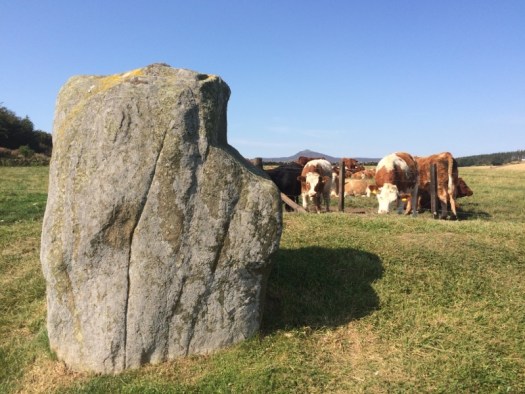
The Rocking Stones of Auchmaliddie, situated near the village of New Deer in Aberdeenshire, are thought to be the remnants of a recumbent stone circle. Only the large recumbent and one flanker remain. They are made of white quartz which lights up under the moon and sparkles in the sunlight. What an impressive circle it would have been when whole! Most recumbent circles in the Grampian region are aligned to moon cycles so moonlight quite possibly featured in their use.
They are still beautiful, I think. Even in driving hail, as they were when I visited recently.
The quartz.
The black line there is comprised of straw bales wrapped in plastic. The stones are located at the edge of a field.
Folklore of the Rocking Stones
Local folklore suggests that the stones, also known as the Muckle (huge) Stanes of Auchmaliddie, were once placed on top of one another. It is said that if a person were to stand on them and tell a lie, the top stone would tip.
A Stone Circle, Destroyed
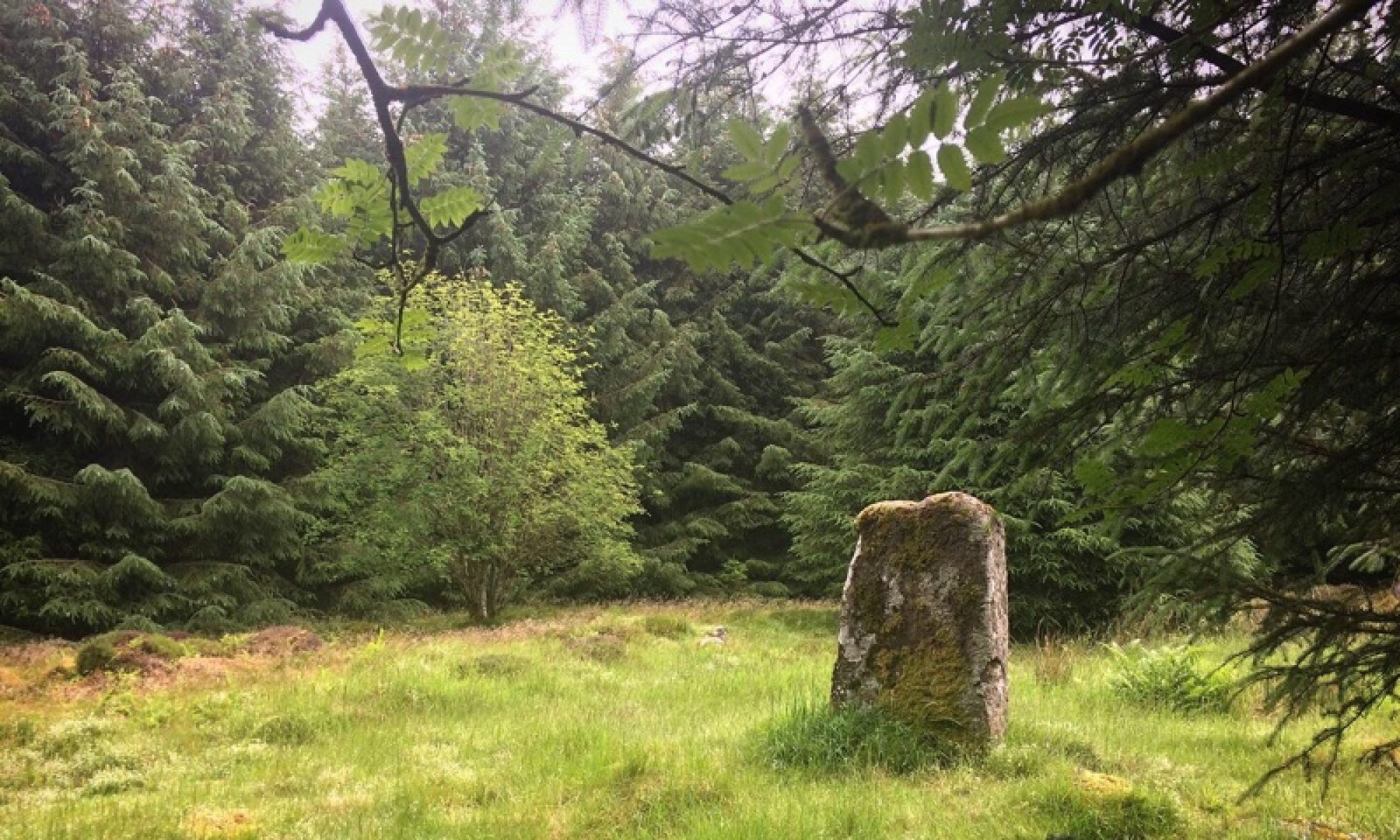
The rocking stones have fared better than the stone circle that stood on the hill, just a mile or so away, at the other side of the village. In the 18th century it was smashed up and used in the foundations of the new manse. Bad luck is said to befall anyone who lives on the surrounding lands. The nearby farm is called Standing Stones. Below is the hillside where the circle would have been, Culsh Monument to the right.
Quote from interview: My next historical novel explores the relationship between two chosen sisters who flee abuse together as young children. They are as close as two people can be and I am still working on conveying that closeness and the deep understanding that exists between these young women as they negotiate their own romantic liaisons with men, both approved and unapproved by their community, and as their Bronze Age society marches into war. (Now published. See SISTERS AT THE EDGE OF THE WORLD).
Or maybe my books, all of which feature a stone circle:
Set in 1st century Scotland, SISTERS AT THE EDGE OF THE WORLD includes the battle of Mons Graupius between the Romans and the Caledonian tribes. The book features a neurodivergent main character and some rather complicated romance!
Taking place mainly in a castle, THE MERMAID AND THE BEAR blends an often overlooked period of history, the Scottish witchcraft accusations, in particular the 1597 Aberdeen witchcraft panic, with a love story.
FIREFLIES AND CHOCOLATE was inspired by the kidnapped children and young people of Aberdeen. The story follows the adventures of Elizabeth Manteith from the castle and her determined efforts to get back home. There’s love. There’s derring-dos on the high seas… And there’s chocolate!
This Candlemas (2nd of February) post was originally published in 2014.
Hot at Candlemas
I just sat in the hot place. It was good. It was sunny and bright, though it offered only a vague warmth today.
The ‘hot place’ is a point on our property that is sheltered from both north and east winds by walls, and situated next to large windows that reflect the sunlight and bestow a sort of ‘double sunning’. It is rather like a portal to another country, a warmer clime or different season. In summer it can reach unbearable temperatures. In the deepest months of winter the sun doesn’t touch it at all. This was the first time it lit up this year, fitting then that it’s Groundhog Day (wiki), Candlemas (wiki) and Imbolc (wiki).
Feeling the sun on my face, without the usual buffeting wind, was a good reminder that the Earth is turning and spring is on its way. More good reminders: brave little snowdrops.
Cold at Candlemas
It’s been an odd winter, very dark but with none of the usual bright and dramatic snow of Scotland. The continual rain, mud and roof leakages have made the season seem long and arduous. Grey. Dull. No enchanted snowy moonlit walks where surprised owls fly low overhead, no snow angels or sledging. I almost miss having to dig my way into the woodshed (almost, not really; it was fairly tortuous, and nasty when ice dripped down your neck too). Solstice 2010:
The wind has been notably fierce, bringing an ancient beech tree crashing to the ground one night. I heard it from my bed half a mile away. Three loud cracks sounded as its branches broke. How disorienting to stand among high boughs and look through to what was the ground, upended like the tree:
The world on its side. An oliphaunt fallen.
So, winter: snow properly, or let spring through. The sun is nice today; I’d like more of that, please, I’m ready to laze in the hot place with a book. And if the saying below is true, there’s hope for that.
Traditional Candlemas Rhyme
If Candlemas Day is clear and bright, winter will have another bite. If Candlemas Day brings cloud and rain, winter is gone and won’t come again.
And the Scottish version:
If Candlemas Day be dry and fair,the half o’ winter’s to come and mair. If Candlemas Day be wet and foul,the half o’ winter’s gane at Yule.
Chosen Sisters, Romans and Romance
Set in 1st century Scotland, SISTERS AT THE EDGE OF THE WORLD includes the battle of Mons Graupius between the Romans and the Caledonian tribes. The book features a neurodivergent main character and some rather complicated romance.
Review from Terry Tyler: “It’s a fabulous story, a real page-turner and so well written. It made me think about the passage and circle of time, of the constancy of the land on which we live and the transient nature of human life. Loved it.“
The part of the book that has been most highlighted by kindle readers
My New Series
The first title – Ariel: Dancing on TV
The night before Ariel, a sixteen-year-old girl with a deformed hand, starts at the most prestigious dance school in Scotland, her mother tries to kill her.
Torn from a life where she never fitted in, Ariel quickly becomes the focus of a reality TV show. In the castle school, she forms deep friendships and meets Alexander, the best looking boy she’s ever seen. Together, they unravel the mysteries of the castle’s shadows and confront the demons of Ariel’s past.
Can she rise above a lifetime of pain and embrace the possibilities of fame and love that beckon to her?
‘Ariel: Dancing on TV’ is a mesmerising tale of resilience and the pursuit of a brighter future against all odds.
The Performance: sometimes going home for Christmas is just one huge performance…
When Ariel returns home from dance college, her mother expects her to perform the Dance of the Sugar Plum Fairy in a pink, sequined tutu in front of many, many party guests. Ariel adjusts the costume and choreography to expose dark truths about her life, but, as it turns out, this is not the biggest performance of the night…
New Books and Special Offers
If you would like to hear about new books and special offers, you can follow my Amazon author page.
The Dule Tree at Leith Hall is one of the best known examples of this type of historical tree. It is said to have been used as both a gallows and a gibbet in the past. The house dates from the 17th century, so the macabre use of the tree probably does too.
Another Dule Tree Tradition
There is a gentler tradition associated with dule trees. They were possibly used as places of mourning. The word ‘dule’ derives from Gaelic, and means grief.
Me, actually in the tree, trying to take a photo from an interesting angle:
Sign up to the mailing list for news about my life and writing, and some exclusive photos. If you would rather just hear about new books and offers, you can follow my Amazon author page.
SISTERS AT THE EDGE OF THE WORLD
Set in 1st century Scotland, SISTERS AT THE EDGE OF THE WORLD includes the battle of Mons Graupius between the Romans and the Caledonian tribes. The book features chosen sisters, fierce warriors, a neurodivergent main character and some rather complicated romance
Taking place mainly in a fictional castle, THE MERMAID AND THE BEAR blends an often overlooked period of history, the Scottish witchcraft accusations, in particular the 1597 Aberdeen witchcraft panic, with a love story. There’s 6 chapters of medieval Christmas too.
FIREFLIES AND CHOCOLATE was inspired by the 600 children and young people who were kidnapped from Aberdeen during the 1740s and sold into indentured servitude in the American Colonies. The story follows the adventures of Elizabeth Manteith from the castle and her determined efforts to get back home. There’s love. There’s proper derring-dos on the high seas… and there’s chocolate!