The coffin bridge is a striking sight as you walk or drive over the modern road bridge in the Highland village of Carrbridge. The old packhorse bridge was built in 1717 for the price of £100 to allow funeral processions to cross the River Dulnain.
The bridge has suffered much damage from weather and high waters over the years. It used to have both sides and parapets. Image from the informational sign on site:
It’s a beautiful piece of architecture, about 2 metres wide between the old sides.
The river beyond:
I hope the coffin bridge doesn’t crumble away too soon…
Sisters at the Edge of the World
When Morragh speaks to another person for the very first time, she has no idea that he is an invader in her land…
Set in 1st century Scotland, SISTERS AT THE EDGE OF THE WORLD includes the battle of Mons Graupius between the Romans and the Caledonian tribes. The book features a neurodivergent main character and some rather complicated romance…
Deer Abbey in Aberdeenshire is a beautiful sprawling ruin. It’s a peaceful place to visit. Reflective. A place to peer through old doorways into the past.
Into the kitchen…
The Man Trap
If I look back into my own past, I see myself in quite a state, just about to go into hospital and become monstrous. I am better this year. Better than that anyway. Able to go out and about to places other than my doctor’s surgery.
Which brings me to the man trap:
Man trap!
You would definitely need some medical intervention after stepping in that! It’s a hideous contraption that was designed to catch poachers, widely used in the 19th century by local Lairds. It’s not known how it came to be at Deer Abbey.
From one of the informational plaques, the man trap in use:
Ouch!
History of the Abbey
For 340 years, the Abbey housed a Cistercian community. The monks of Deer wore white robes and no underwear, a brave choice given Aberdeenshire’s low temperatures and the strong gales of winter.
Cloisters
After the reformation the building became the property of the Keith family. Mrs Keith dreamed of angry monks coming to destroy her home, Dunnottar Castle. And more recently, there have been sightings of a ghostly monk on the main road outside the Abbey. Maybe the old Cistercians do not rest easy yet.
A boundary of yews.
Remaining Beauty
I love the ancient trees of the Abbey grounds. And the pink hue of the crumbling walls. The hillside beyond is satisfyingly timeless, and probably offers quite a similar view to the one that the white robed monks looked out on.
An Autistic Dancer, a Byronic Hero and an Obsessive Scientist
Read my series A Dancer’s Journey. There’s ballet. There’s lots of naughtiness. And there’s peril!
Enjoy a kiss on the London tube in the first book, TENDU. Romp up and down the castle stairs. Dance in a stone circle. Attend a Ceilidh in the great hall. Have your brain studied in the dungeon. All fun, I assure you. Well, not quite all…
And there’s also this slightly strange little post about what the characters of A Dancer’s Journey get up to when I take a rare day off from writing.
Newsletter, Updates and ARCs
Go here to sign up for occasional emails that always include exclusive photos and news of my writing and life. They’re a bit more intimate than the blog. If you would like to hear about new books and offers, you can follow my Amazon author page.
The Map of Accused Scottish Witches is a wonderful resource from the University of Edinburgh, utilising the extensive data collected in their Survey of Scottish Witchcraft Database. See it here.
It’s a clickable map of over 3000 people accused of witchcraft in Scotland. It’s both fascinating and terrible as this subject always is. My three quines from THE MERMAID AND THE BEAR are included (see Isobell’s entry above) as are a disturbing Witch Pricker’s Journey and various other stories. You can choose to view a modern map or a historical one, the latter suiting it better, I think.
The map and database were extremely useful to me when researching and writing about this subject.
Excellent piece from @NeilDrysdale. I cite the case of Bessie Thom in the article, a woman who features in THE MERMAID AND THE BEAR, as an example of what happened to one of the more than 3,000 victims of the witch trials.
“Bessie, quite possibly, went into the North Sea before being committed to the flames during a very public execution.”
The Beauty of Autumn
After peering into the dark, I need to look at beauty, so here’s some golden autumnal goodness:
And the path up to St Drostan’s well, shining in the golden sunlight:
Newsletter
Keep up to date with all my news, witchy and otherwise, by signing up to the mailing list. It’s a more intimate space than the blog and always contains some exclusive photos. If you would like to hear about new books and offers, you can follow my Amazon author page.
Contemporary Fiction
Scotland’s all misty lochs and magical forests and perfect boyfriends, right?
When dance student Amalphia Treadwell embarks on a secret relationship with her rich, handsome teacher, she has no idea of the danger that lurks in his school in Scotland…
My dance background and love of history and spicy stories are what inspired this heady mix of contemporary romance and ballet set in a castle. Readers of my historical fiction will recognise the castle and stone circle that feature in these books.
There are no cliffhanger endings in this series; each book completes a story, but then there is more. So much more. Read all the blurbs here
Historical Fiction
These novels combine little-known dark events with love stories and a hint of magic.
The seals were shown to me by a direct descendant of Lord Pitsligo while I was researching FIREFLIES. I got to hold them and turn them on their hinges, which was wonderfully informative and exciting. It was great to connect to the time of the book like that too.
The Book
FIREFLIES AND CHOCOLATE was inspired by the kidnapped children and young people of Aberdeen. The story follows the adventures of Elizabeth Manteith from the castle, and her determined efforts to get back home. There’s love. There’s derring-dos on the high seas… And there’s chocolate!
I wandered through the woods to the 18th century Duff House Mausoleum.
It’s about a mile away from majestic Duff House, which is now an art gallery, and about two miles from the Bridge of Alvah. When I was a child, the house was in quite a rough state. Furniture was covered in sheets, paint was peeling off the walls, and spooky music floated up from the lower levels.
I loved it.
I still do.
Duff House
The Mausoleum
Round the back…
The effigy of a knight is not Robert the Bruce as once purported by the Earl who built the mausoleum. The skulls, crossbones and wheat are quite common on older graves in Aberdeenshire.
Below: the interior of the mausoleum.
The River Deveron
During autumn in Scotland the days seem to be either golden or grey, sunny or dreich. It didn’t get properly light at all on this day, but autumn added its gold regardless.
Dickensian Dog Graves
I came upon an old dog grave in the lower parts of Wrack Wood. The dogs had lovely Dickensian sounding names.
Grey and golden, the colours of the day:
Chosen Sisters, Romans and Romance
Set in 1st century Scotland, my latest novel, SISTERS AT THE EDGE OF THE WORLD, includes the battle of Mons Graupius between the Romans and the Caledonian tribes. The book features a neurodivergent main character and some rather complicated romance.
I do seem to have a habit of running up and down the medieval cobbles, or ‘cassies’, of Aberdeen in the name of research.
Correction Wynd
Here I am again, travelling down Correction Wynd, site of the 17th century House of Correction. But it’s not the old poorhouse/jail that I’m investigating. Not today anyway…
I pass St Nicholas Kirk, where people accused of witchcraft were held in the 16th century.
Researching and writing those times have led me to another.
Over the cobbles I go, glancing up at the modern city above.
Over the Cobbles to the Green
Through the beam of light and into the, also rather modern seeming, Green.
The kidnapped children of Aberdeen were held here in the 1740s. In a barn.
Passers by sometimes heard music coming from the place as the kidnappers tried to keep the children entertained.
These events inspired my novel Fireflies and Chocolate, and the Green is specifically mentioned:
“Another barn,” notes Peter, when we are ushered into a large ramshackle wooden building. Again we find a space to sit together, among the others. Again, we are on the floor, this time an earthen one. No chairs are provided for the likes of us anywhere now it seems. “I was kept in a barn in Aberdeen,” he tells me. “Down at the Green.”
I ken the Green. I used to think it was a nice place to walk through, a space between buildings, like a city version of a forest glade.
The Tolbooth
The children were also kept in the Tolbooth at times. There are tales of desperate parents trying to break down the door to get to them. Peter Williamson, who appears in the above quote, would be held there again in later life as punishment for his book, in which he accused the town magistrates of involvement in the kidnappings. You can read a large print version in the Tolbooth museum today beside a life size cut out of Peter!
He’s not the main character in Fireflies and Chocolate, though. That’s Elizabeth Manteith, who is entirely fictional. But I love her. In their press release about the book the publisher describes her like this:
Fiery and forthright, Elizabeth isn’t someone to be argued with. She knows her own mind, and isn’t afraid to speak it. Through her experiences, the reader sees her grow from a girl, into a woman with a powerful voice… a woman of her time, but very much of ours too.
Those dark cobbles of Aberdeen do take me places!
The Book
Torn out of her isolated life in a Scottish castle, Elizabeth embarks on a determined quest to return home. Exhilarating adventures unfold on the high seas, love blossoms, and the chocolate, purchased in Ben Franklin’s printing shop, is delicious!
FIREFLIES AND CHOCOLATE was inspired by the 600 children and young people who were kidnapped from Aberdeen during the 1740s and sold into indentured servitude in the American Colonies.
The Fairy Glen, on the Black Isle, is an enchanting woodland with stunning waterfalls and pools. Not to be confused with the Fairy Glen on the Isle of Skye (see it here).
Keeping the Fairies Happy
Children used to dress a pool within the glen to keep the fairies happy.
Coins are pressed into a dead tree, today for wishes or luck. In older, darker tradition these tree coins were an offering to the fairies to ask them not to exchange babies for changelings.
Walking in the Fairy Glen
The atmosphere of the Fairy Glen is joyful and light. It’s easy to imagine fairies dancing and flying and giggling over the pools and streams. There are nice clear paths and bridges through it all, making it a wonderful place to walk.
Keep up to date with all my news by signing up to the mailing list. It’s a more intimate space than the blog and always contains some exclusive photos.
The Mermaid and the Bear
Isobell needs to escape. She has to. Her life depends on it.
She has a plan and it’s a well thought-out, well observed plan, to flee her privileged life in London and the cruel man who would marry her, and ruin her, and make a fresh start in Scotland.
She dreams of faery castles, surrounded by ancient woodlands and misty lochs… and maybe even romance, in the dark and haunted eyes of a mysterious Laird.
Despite the superstitious nature of the time and place, her dreams seem to be coming true, as she finds friendship and warmth, love and safety. And the chance for a new beginning…
Until the past catches up with her.
Set in the late sixteenth century, at the height of the Scottish witchcraft accusations, The Mermaid and the Bear is a story of triumph over evil, hope through adversity, faith in humankind and – above all – love.
My daughter and I took a little trip to London, baby! (originally posted 2014). It was a heady mix of excitement, fun, sore feet, poignant memories, ballet and food. This post is a veritable photo bomb, so continue reading only if you possess extreme picture viewing fortitude.
Covent Garden in London, baby!
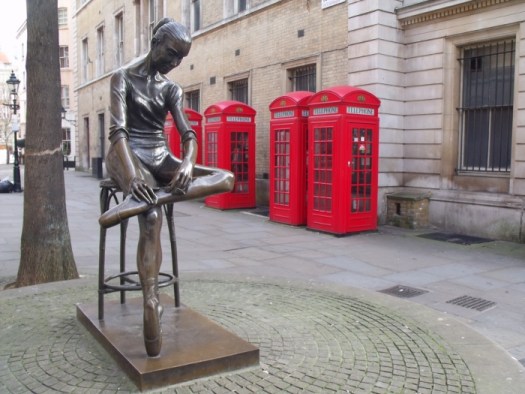
Above is the bridge that joins the Royal Ballet School to the Opera House. Below is bronze of a little dancer opposite the Opera House.
We stayed in Covent Garden. We saw Bill Nighy in the street in Covent Garden. He frowned at us. We like Covent Garden.
Neal’s Yard
The Tube
The Moomin Shop
Quirky Streets
Brydges Place is the narrowest alleyway in London, measuring just 15 inches across where it comes out beside The Coliseum theatre.
This one had fun shops:
Self-indulgent memory alert
The Freed shop was one of the last places I visited before leaving London many years ago. It was to buy a pair of shoes to teach in rather than to dance in, after my body had crumbled… A much happier, sunnier day is shown below, for us if not the staff; there was an angry man in there trying to buy many pairs of shoes in sizes they didn’t have. It was all very dramatic.
Ballet Shoes
Trafalgar Square
I don’t get the blue cock (that is what it’s called) in Trafalgar Square. I’ve read the various excuses explanations for it and they don’t make sense. It’s like a blue joke in an otherwise dignified play… but it is photogenic, so my dislike is not total:
But I prefer the mermaids:
Theatre
We saw the Kings of the Dance at The Coliseum. They were phenomenal, but of course, no photos, other than this pre-show one:
The bar sold chocolate. Just thought I would mention because that impressed me. Right, high heeled boots are abandoned in favour of Bloch dance trainers (an emergency purchase) and on we go.
Shakespeare in Leicester Square. Prime London, Baby!
M&M store
Piccadilly Circus
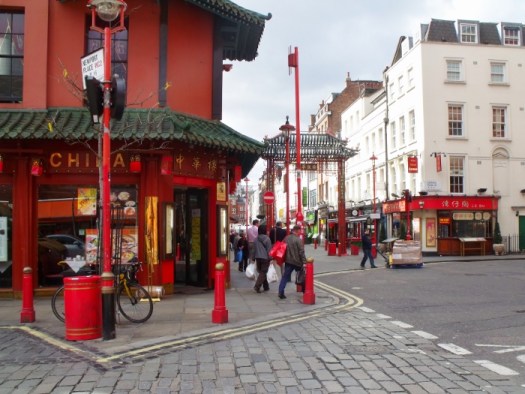
Chinatown
Year of the Horse
The Rudest Restaurant in London (and one of the best and cheapest)
Wong Kei, formerly the ‘rudest restaurant in London’ (still quite curt and bossy to be honest), and a haunt of my youth due to the excellent and cheap food:
The jasmine tea is free and unlimited, just leave the lid of your pot open and it will be replaced.
British Museum
This iron age helmet was found in the River Thames beside Waterloo Bridge. I want one.
Naked statues in Soho Square
And finally (I promise)…
The London Eye
My camera really doesn’t do night.
Well done. One and all.
Series: A Dancer’s Journey
My dance background and love of history and spicy stories are what inspired this heady mix of contemporary romance and ballet set in a castle. Readers of my historical fiction will recognise the castle and stone circle that feature in these books.
A Dancer’s Journey is available in paperback, Kindle and on Kindle Unlimited.
Enjoy a kiss on the London tube in TENDU. Romp up and down the castle stairs! Dance in a stone circle. Attend a Ceilidh in the great hall. Have your brain studied in the dungeon. All fun, I assure you. Well, not quite all…
Go here to sign up for occasional emails that always include some exclusive photos and news of my writing and life. They’re a more intimate space than the blog. If you would rather just hear about new books and offers, you can follow my Amazon author page.
It incorporates the 1597 Aberdeen witchcraft panic.
There’s a stone circle.
There’s 16th century Christmas.
And there’s a love story.
Cover:
A witchy debut novel: THE MERMAID AND THE BEAR
Blurb:
Isobell needs to escape. She has to. Her life depends on it.
She has a plan and it’s a well thought-out, well observed plan, to flee her privileged life in London and the cruel man who would marry her, and ruin her, and make a fresh start in Scotland.
She dreams of faery castles, surrounded by ancient woodlands and misty lochs… and maybe even romance, in the dark and haunted eyes of a mysterious Laird.
Despite the superstitious nature of the time and place, her dreams seem to be coming true, as she finds friendship and warmth, love and safety. And the chance for a new beginning…
Until the past catches up with her.
Set in the late sixteenth century, at the height of the Scottish witchcraft accusations, The Mermaid and the Bear is a story of triumph over evil, hope through adversity, faith in humankind and – above all – love.
Review from Tonya Ulynn Brown: Yes, it is written in one of my favorite time periods, and yes it takes place in one of my favorite places in all the world, but when you combine that with the almost poetic style of Sinclair’s writing—sigh!
Review on Terry Tyler Book Reviews: Suddenly I realised that I’d gone from thinking ‘yes, this is a pleasant enough, easy-read’ to ‘I’m loving this’.
This is an excellent piece from @NeilDrysdale in which I cite the case of Bessie Thom, a real woman who features in THE MERMAID AND THE BEAR: Bessie, quite possibly, went into the North Sea before being committed to the flames during a very public execution.
Aesthetic
I made a wee aesthetic for the book, because: oh the fun!
Go here to sign up for occasional emails that always include exclusive photos and news of my writing and life. They’re a bit more intimate than the blog. If you would like to hear about new books and special offers, you can follow my Amazon author page.
This beautiful tree sits at the foot of Dunnideer Vitrified Hillfort near Insch in Aberdeenshire. It’s a short but steep climb to the top of the hill. When you see the remains of the medieval castle and prehistoric fort, you know you’re nearly there.
Dunnideer Vitrified Hillfort
The vitrified forts of Northern Scotland are a bit of a mystery. About 2000 years ago the stones of many of these defensive buildings reached a high enough temperature to melt. Theories as to how this happened are varied. Battles? Ancient building techniques? Aliens? I’ve written a dramatic stone-melting event into SISTERS (no aliens involved) but don’t pretend to have the answer to this piece of prehistory.
The views from the hill make all exertion of the climb worthwhile. Click the pano for a larger version:
View from the other side:
Dunnideer Stone Circle
Nestled, and almost completely hidden, under a tree at the bottom of the hill are the remains of Dunnideer Recumbent Stone Circle.
Leith Hall Garden
A few miles further west is Leith Hall with its wonderful walled garden.
Stone guardian at the gate:
I love the Moon Gate and, in retrospect, wish I had gone through it and taken a photo from the other side too. Passing through moon gates is meant to bring good luck. Oh well, next time…
SISTERS AT THE EDGE OF THE WORLD
Set in 1st century Northern Scotland, this is a story of chosen sisters, fierce warriors, divided loyalties and, ultimately, love. It features a neurodivergent main character (own voices), the battle of Mons Graupius between the Romans and the Caledonian tribes, and some rather complicated romance!
My dance background and love of history and spicy stories are what inspired this wild mix of romance and ballet set between a Scottish castle and London.
There are no cliffhanger endings in this series; each book completes a story, but then there is more. So much more. Read all the blurbs here
When dance student Amalphia Treadwell embarks on a secret relationship with her charismatic new teacher, she has no idea of the danger that lurks in his school in Scotland…
There’s also this strange little post about what the characters of A Dancer’s Journey get up to when I’m away from the keyboard.
Newsletter
Go here to sign up for my occasional emails that always include exclusive photos and news of my writing and life. They’re a more intimate space than the blog. If you would like to hear about new books and offers, you can follow my Amazon author page.