“There was elf bulls rowtting and skyolling* up and downe there, and they affrighted me.”
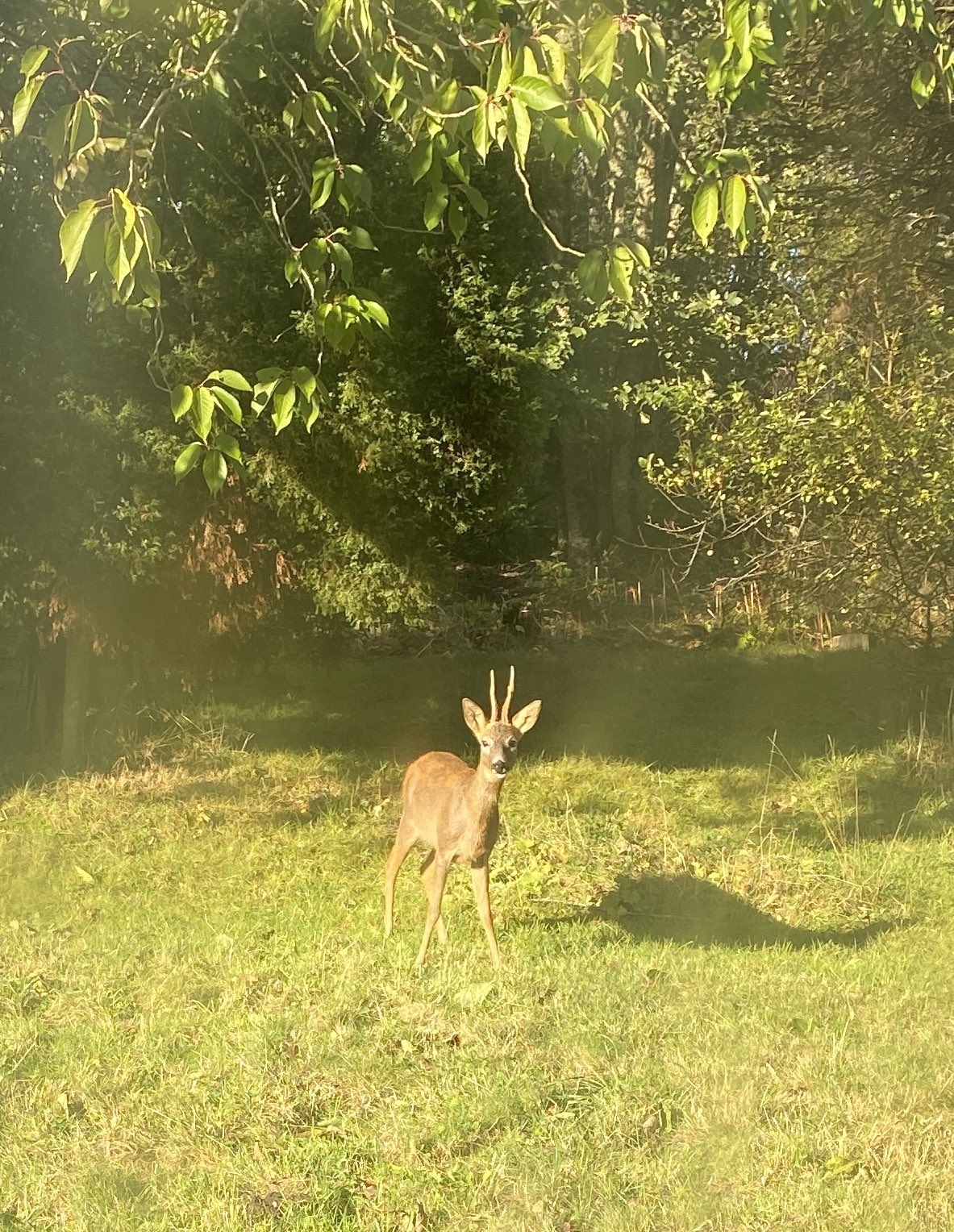
So said Isobel Gowdie, when speaking of Fairyland, in her 1662 witchcraft confession. Deer were sometimes referred to as fairy cattle in the Highlands of Scotland. Could they be Isobel’s elf bulls? I have encountered roaring stags in the woods here in Aberdeenshire, and they certainly affrighted me. The baby pictured was less scary.
The elf bulls, and many other mysteries, I contemplate, and on I go…
* Rowtting and skyolling is usually translated as bellowing and screeching, Isobel’s wonderful words conjuring a truly fearsome noise made by the elfin creatures.
Sisters at the Edge of the World
From the misty hills of ancient Scotland emerges a tale of love, betrayal, and the fight for freedom. Join Morragh in SISTERS AT THE EDGE OF THE WORLD for an unforgettable journey.
“The setting is ethereal and spellbinding as our main characters walk a fine line between what has been and what is to come. A beautiful tale of ancient wonders and kindred souls.” Historical Novel Society review
I love the feel of early autumn. The bees and butterflies descend on the mint flowers. And the atmosphere in the forest is quieter somehow. Slowed down. Mellow.
Roadsides change colour. Bronze appears in the hedgerows.
And, as a herd of wild weetabix graze gently in the field, I write on. The manuscript is back from the editor and, though the content of this last paragraph may suggest otherwise, I am seeking to add clarity and sense to the many unusual details of Isobel Gowdie’s story.
My First Witchy Novel
Taking place mainly in a castle, THE MERMAID AND THE BEAR blends an often overlooked period of history, the Scottish witchcraft accusations, in particular the 1597 Aberdeen witchcraft panic, with a love story.
Amazon review: There is a core of grittiness at the heart of this book, which despite the celebration of strong love and friendship, also examines the consequences of bitter envy, greed and lust.What happens when you become a victim of such people? How do you deal with the aftermath? These are gnarly questions that Sinclair didn’t sidestep for the sake of a cosy read and this beguiling, wonderful book is the richer for it.
A high speed wind was hurtling through the sea cave at New Aberdour beach as I took the photo above. I nearly blew over. But it was worth it to capture that combination of dark and light and blue and black. That tunnel of transition from enclosed space to open sea.
The beach is never busy, being a bit far from main roads and civilisation. I do recommend seeking it out if you are ever in Northern Aberdeenshire. It has sandy bits for summer picnics and sunbathing. There are stony bits that noisily orchestrate the retreat of the waves.
Then there’s the magnificent caves:
Some entrances are almost hidden…
This next one I always avoid. I once overheard a highly respected educational psychologist, who I knew from my time working in schools, emotionally blackmailing a small child to defecate in there. Such memories are off-putting, plus, the roof is rather head-bangingly low…
But New Aberdour beach as a whole is lovely. Apart from the car park, there is no sign of the modern day, you could be meandering through any time, any era.
Folklore
Some specific points in history and local folklore are marked. St. Drostan is said to have landed at New Aberdour in 580AD. His well:
The Heroine of New Aberdour Beach
And the heroic actions of one Jane Whyte, who rescued fifteen men from a shipwreck in 1886, are commemorated in the remains of her little cottage:
When the tide is out the rockpools display all manner of sea life from minnows to sea slugs, starfish, pipefish and anemones. Tide allowing again, you can walk for miles round bay after bay. Do watch the sea though, there’s no mobile phone reception down there if you get stranded. Sometimes you catch sight of dolphins and whales.
I sound like a guidebook, a representative of Scottish tourism… but I’m not.
I’ve visited this place at times of trauma and felt negativity drain away into the pink rocks. I’ve lain on the sand reading books during hot relaxing summers while my children explored the pools and searched for cowrie shells. And I’ve introduced all my friends to the beach. So memories of New Aberdour are mixed up with those of my favourite people.
“We walked along grassy clifftops and looked out at the sea, a sea that was some days brilliant blue, others stormy grey; green and pink stones showed in the shallows by the craggy bays. We saw dolphins. We saw seals. I waved and called out to my brown-eyed friends.
The wind swept us clean, leaving the taste of salt on our lips and our manes wild and unkempt. We only went down onto the sandy beaches; I would risk some things, but not Selkie feet on rocky shores. We found places where waves crashed so high they shot out of the very land itself. They roared in celebration of their watery power; I instinctively hugged tight to my horse’s neck then as she reared up with the waves in some Kelpie joy of her own.”
For years I passed by the road signs for Findlater Castle on my way to other places, joking that ‘I must find that later’. I’m so glad I finally did. I’ve been a few times now, and it’s always stunning.
On the day pictured here, it was exceptionally warm and still which emboldened me to go a bit further down onto the ramparts than I’ve been before.
Climbing up to the Castle
Off I went, past the gorse which was warmed by the sun and smelled all coconutty…
I reached my normal stopping place, this first chunk of wall…
And I continued on up the wee path for a peek at the shore beyond.
With no gusts of wind to blast me off the edge, on I marched, or tentatively crept, as is more accurate.
Look at those craggy walls!
The Findlater Castle Ghost
I sat down on the grass and contemplated being really brave and jumping down that hole under the archway. Ah, the photos I would get, the spectacular views I would see, and the incredible atmosphere I would experience…
Then I remembered the ghost story. A small boy and his nurse were standing near an open window, maybe even one of those in view, when he jumped from her arms and disappeared down the side of the cliff, presumably to his death. She scrambled after him, also to her doom, and her spirit still haunts the castle searching for her errant charge.
I really didn’t want to join her.
So, sorry to disappoint, but after another look over the edge, I retraced my steps back up the hill.
Doocot
This meant I survived to visit the nearby Doocot (pigeon house). It dates from the 15th century as does the castle.
I love its door:
And all the little nesting boxes within:
Visiting Findlater Castle
If you visit the castle, do be careful not to fall to your doom. If it’s muddy or windy, it would be much more dangerous than it was for me on this occasion. Look, the council have even written a warning in great big red letters underneath the history:
Necessary risks only, then 🙂
The Mermaid and the Bear
Taking place mainly in a fictional castle, THE MERMAID AND THE BEAR blends an often overlooked period of history, the Scottish witchcraft accusations, in particular the 1597 Aberdeen witchcraft panic, with a love story.
The Performance: sometimes going home for Christmas is just one huge performance…
When Ariel returns home from dance college, her mother expects her to perform the Dance of the Sugar Plum Fairy in a pink, sequined tutu in front of many, many party guests. Ariel adjusts the costume and choreography to expose dark truths about her life, but, as it turns out, this is not the biggest performance of the night…
New Books and Special Offers
If you would like to hear about new books and special offers, you can follow my Amazon author page.
Tomnaverie Recumbent Stone Circle is rather an unusual site. Thought to date from 2500 BC, this circle suffered great damage due to 20th century quarrying, but was put back together during an archaeological excavation in 1999.
The mound that the stones stand on was formed by a build up of residues, including human bones, from the site’s previous use as a place of cremation.
The Circle of Stones at Tomnaverie
I always love that first glimpse of standing stones in the landscape.
Lady’s bedstraw, harebells, ox-eye daisies and yarrow grow all around the stones.
The recumbent stone and flankers frame Lochnagar when you stand in the middle of the circle. I visited on an overcast and misty day, so the mountain was not visible.
The mist added to the timeless atmosphere of the place.
Through the stone gateway, along a path and past a field we go now, to a somewhat less timeless place.
Tomnaverie Nuclear Bunker
This bunker was built for the Royal Observer Corps in 1959 to monitor potential nuclear strikes during the Cold War.
People, many recruited and trained locally, stayed here until the Royal Observer Corps was officially stood down in 1991.
Picture from the informational sign by the bunker
I found myself drawing parallels with the nearby Culsh Earth House: people going underground at times of conflict, separated by millennia but in close proximity to each other geographically.
And, above it all, the flowers grow on.
All my books feature standing stones
Set in 1st century Scotland, SISTERS AT THE EDGE OF THE WORLD includes the battle of Mons Graupius between the Romans and the Caledonian tribes. The book features a neurodivergent main character and some rather complicated romance!
Taking place mainly in a castle, THE MERMAID AND THE BEAR blends an often overlooked period of history, the Scottish witchcraft accusations, in particular the 1597 Aberdeen witchcraft panic, with a love story.
FIREFLIES AND CHOCOLATE was inspired by the kidnapped children and young people of Aberdeen. The story follows the adventures of Elizabeth Manteith from the castle and her determined efforts to get back home. There’s love. There’s derring-dos on the high seas… And there’s chocolate!
When dance student Amalphia Treadwell embarks on a secret relationship with her charismatic new teacher, she has no idea of the danger that lurks in his school in Scotland…
The Performance: sometimes going home for Christmas is just one huge performance…
When Ariel returns home from dance college, her mother expects her to perform the Dance of the Sugar Plum Fairy in a pink, sequined tutu in front of many, many party guests. Ariel adjusts the costume and choreography to expose dark truths about her life, but, as it turns out, this is not the biggest performance of the night…
New Books and Special Offers
If you would like to hear about new books and special offers, you can follow my Amazon author page.
More officially known as the Merchant’s House, this lovely building’s date of origin is a little uncertain. The other houses in the row were all built in 1575, but the Pink House has this declaration on its wall:
A mistake may have been made.
But, oh: a turret!
The Interior
I passed through bedrooms with beautiful wallpaper and entered the courtyard garden.
The owner of the house told me about the historically authentic paint, made with ox blood, and she also pointed out the books in that higher window to the right.
The Book Nook
Much as I wanted to just stay there in the nook – or perhaps even live in it – there were other places to explore.
Door to the loft and turret room:
In the turret:
Loft:
Robert Burns is said to have slept in the loft while working as an excise man in Banff. It was the only place in the house that felt a little creepy.
I did miss a few rooms. Though the owner assured me I could explore everywhere, I was aware that her family were having breakfast in the kitchen, and it just felt too intrusive to go through there.
The house as seen through the gate of the medieval graveyard across the street:
Sign up to the mailing list for news about my life and writing, and some exclusive photos. If you would like to hear about new books and offers, you can follow my Amazon author page.
Small update, July 2026: a year on, and my Isobel Gowdie novel is in its third draft… It’s strange and dark, and I’m loving it. And the mural has had a colourful wee glow-up (above), as seen on my last visit to Auldearn.
Original post from June 2025
I shall go into a hare, With sorrow and syt and meickle care; And I shall go in the Devil’s name, Ay while I come home again.
The quote is part of the extraordinary witchcraft confessions of Isobel Gowdie from 1662. She confessed to shape-shifting, flying, and various activities involving the devil, and it’s said that she offered this information without torture.
There’s no record of torture, just as there’s no record of Isobel’s execution, but, of course, this doesn’t mean these events didn’t happen.
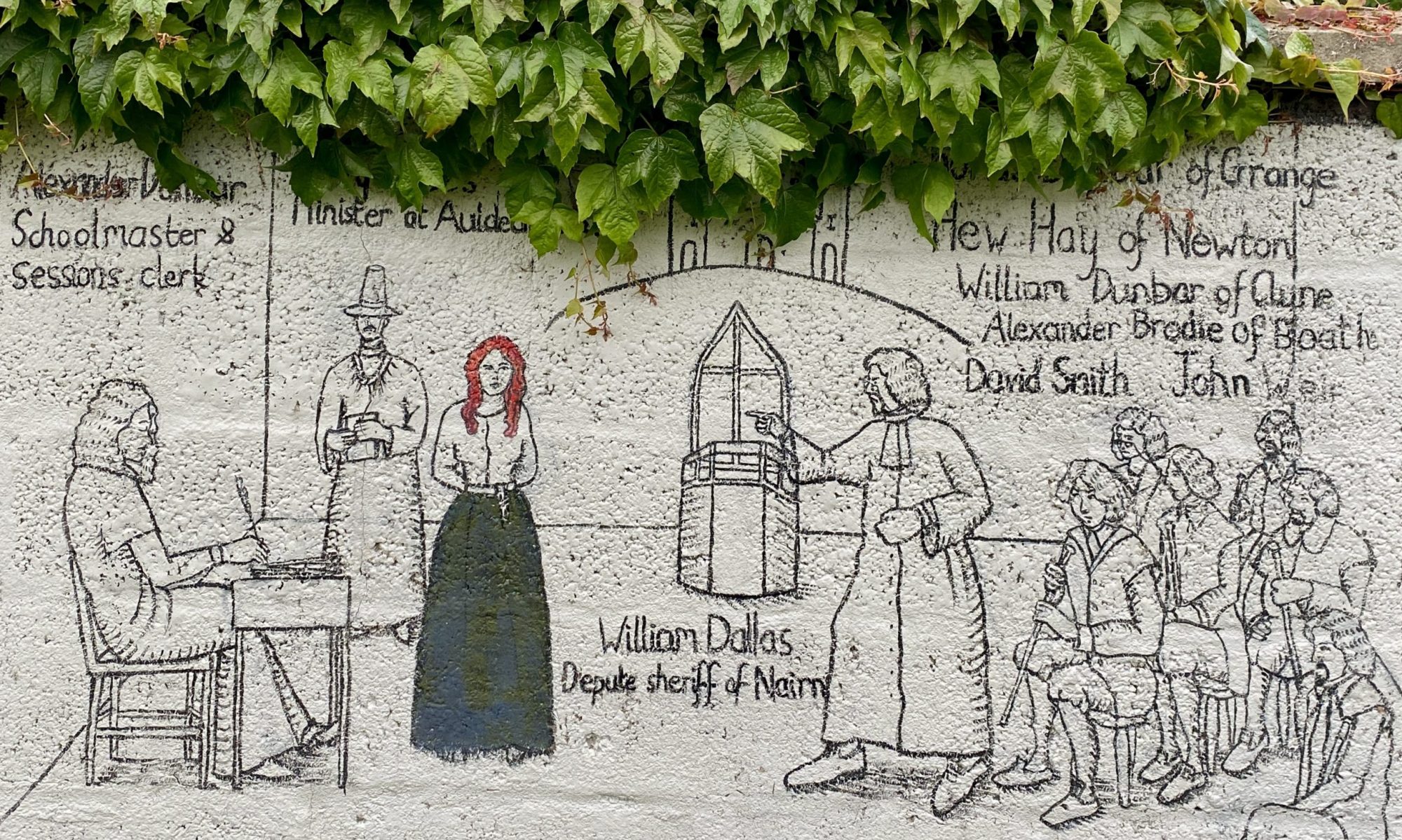
Mural of Isobel Gowdie
It was wonderful to meet artist Helen Wright when my research took me to Auldearn. She has created a beautiful mural depicting the life of Isobel. In the panel above, it is theorised that Isobel may have earned money telling stories to children, an occupation that was available to local women at the time. The tone and narrative of the confessions do suggest she was a gifted storyteller.
The Battle of Auldearn
The battle of Auldearn between the Covenanters and Royalists took place in 1645. There were still troops at Auldearn in 1647, the year when Isobel claimed she had carnal relations with the devil. This part of the confession is lurid and detailed, and, to me, it seems to be some sort of trauma response.
It was great to meet the artist today. From Isobel’s confession (apparently obtained without the usual t0rt*re): I shall go into a hare, With sorrow and sych and meickle care; And I shall go in the D€vil’s name, Ay while I come home again. #history#art#mural#witchcraft#womensart#authorlife#research
You’d think the old kirk where Isobel set some of the meetings with the devil and others would feel creepy and dark. It was atmospheric, yes, but it seemed welcoming somehow. I wanted to stay inside it as if someone had ushered me in and offered me tea.
Interior of the kirk:
So that’s where my writing research has led me… and there’s LOTS of reading to do.
My debut novel involved such research too, and another Isobell…
Set in a fictional castle in Aberdeenshire, Ailish Sinclair’s debut novel, THE MERMAID AND THE BEAR, blends an often overlooked period of history, the Scottish witchcraft accusations, in particular the 1597 Aberdeen witchcraft panic, with a love story.
Published by GWL Publishing, the book is out in paperback and Kindle now.
The Performance: sometimes going home for Christmas is just one huge performance…
When Ariel returns home from dance college, her mother expects her to perform the Dance of the Sugar Plum Fairy in a pink, sequined tutu in front of many, many party guests. Ariel adjusts the costume and choreography to expose dark truths about her life, but, as it turns out, this is not the biggest performance of the night…
New Books and Special Offers
If you would like to hear about new books and special offers, you can follow my Amazon author page.
Migvie Kirk, near Tarland in Aberdeenshire, is misleadingly unimposing when you first see it. The present structure, now deconsecrated, dates from 1777, though there was an older medieval church there from at least the 12th century.
That was as much as I knew about the Kirk when I visited the kirkyard to see the Pictish stone, so what transpired was all rather delightful.
The Migvie Stone
This is a class II Pictish stone thought to date from the 8th century. This class of stone has a cruxifix on one side and traditional Pictish symbols on the other, unlike earlier stones which just display the older Pictish designs. Another good example is the Maiden Stone near Inverurie.
The cross is clearly visible on the Migvie Stone, but the other side is very worn and lichen covered, so I struggled to make out the images.
But all was about to be made clear…
Migvie Kirk
I’m nosy about old buildings. I push doors to see if they’re open, and this one was. It showed pitch-black darkness inside though, and having just encountered the same at the Culsh Earth House, I reached for my torch.
I stepped inside, and then there was light.
Motion sensors had activated lights and revealed a wonderful space which is now used for quiet contemplation and also as an arts venue. The interior of the door is carved with the symbols from the stone outside. The cross has loops as if it’s hanging on a necklace. Most unusual!
The landowner, along with local craftsmen and artists, renovated the derelict Kirk, after a battle with the council who had lost the original plans, and the work completed in 2001.
There’s a second Pictish stone inside:
Fragments are embedded in the walls too. I liked these Pictish feet:
The artwork and inscriptions are made up of a mixture of Christian writings, Pictish symbology and biblical passages written in both English and Ogham.
At one point, when all was still, the lights blinked off and everything went pitch black again.
Moving about soon summoned the light.
I intend a return to Migvie. I missed a cup-marked stone in the kirkyard and also an inscription of words from William Penn.
Fireflies and Chocolate is set in both Aberdeenshire and Pennsylvania
Torn out of an isolated life in a Scottish castle, Elizabeth embarks on a determined quest to return home. Exhilarating adventures unfold on the high seas, love blossoms, and the chocolate, purchased in Benjamin Franklin’s printing shop, is delicious!
FIREFLIES AND CHOCOLATE was inspired by the 600 children and young people who were kidnapped from Aberdeen during the 1740s and sold into indentured servitude in the American Colonies. The story follows the adventures of Elizabeth Manteith from the castle and her determined efforts to get back home. There’s love. There’s derring-dos on the high seas… and there’s chocolate!
The Culsh Earth House is an Iron Age souterrain near Tarland in Aberdeenshire. Built about 2000 years ago, at the time of Roman occupation in parts of Scotland, this particular earth house is beautifully intact and safe to enter.
You have to crouch or crawl to get in, though, the entrance being very low.
The ceiling gets higher as you progress, and you can finally stand up in the curved end of the passageway.
It’s dry and cool in the earth house, so the theory that these places were used for food storage may be correct. They would also be good for hiding in during times of conflict, and there’s room for a good few people in there. The smallness of the entrance would make it relatively easy to cover.
Or, of course, there could have been a spiritual or ritualistic use.
You certainly head into the light as you, crouching again, leave.
I loved the Culsh Earth House, resembling as it does, the time and some of the settings of Sisters at the Edge of the World. Short video below:
An Iron Age souterrain, rather like some of the settings in SISTERS AT THE EDGE OF THE WORLD. From the misty hills of ancient Scotland emerges a tale of love, betrayal, and the fight for freedom. Join Morragh in SISTERS AT THE EDGE OF THE WORLD for an unforgettable journey. Set in the 1st century, the story includes the battle of Mons Graupius between the Romans and the Caledonian tribes. There’s a neurodivergent main character and some rather complicated romance! #prehistory#booktok
From the misty hills of ancient Scotland emerges a tale of love, betrayal, and the fight for freedom. Join Morragh in SISTERS AT THE EDGE OF THE WORLD for an unforgettable journey.
Set in 1st century Scotland, the novel includes the battle of Mons Graupius between the Romans and the Caledonian tribes. There’s a neurodivergent main character and some rather complicated romance.
I walked across the stubbly field to Inverallochy Castle at the weekend. It’s one of the nine castles of the knuckle, a term coined by historian William Douglas Simpson. It refers to nine ancient castles built along the rocky (knuckle-like) coast of Buchan in NE Scotland. I’ve been to most of them, so here we go!
Close-up of Inverallochy, a Comyn family castle, dating from 1504:
Apparently there used to be a stone above the door stating that the land around the castle “was obtained by Jordan Comyn for building the abbey of Deer.” Deer Abbey and its older site are some miles away – I wrote about the Abbey here – so that’s a little odd. Maybe ancient plans changed, or the inscription was incorrect. The stone disappeared in the 18th century.
Medieval re enactor and ‘Man at Arms’ Andrew Spratt made this GIF showing how the castle used to look:
We’re going to head north from Inverallochy. There were two knuckle castles south of here – Lonmay and Rattray – but they have crumbled away to nothing. I have written about the ancient chapel at Rattray, and its pirate steps, here.
Cairnbulg Castle
Next up the coast is Cairnbulg Castle, one of the oldest buildings in Aberdeenshire still to be inhabited by the family that built it. It’s home to Lady Saltoun, Chief of the name and arms of Fraser.
The Wine Tower
Not actually a castle, but one of the nine anyway, the Wine Tower in Fraserburgh is a post-reformation Catholic chapel. See my post here
On we go to Pittulie Castle, thought to date from 1596, the year that my novel The Mermaid and the Bear begins, so I have an extra fondness for this castle. In the 18th century the owner was friends with the lovely Lord Pitsligo who lived next door.
Pitsligo Castle
This castle started out as a keep (the high part on the right above) in 1424 but expanded greatly over the centuries. See my post on it here.
Dundarg Castle
Sadly, I have no photos of the last of the nine castles of the knuckle, Dundarg, as it’s on private land right by a house. It sits on a promontory within the ramparts of an Iron Age fort. It’s referenced from the 10th century, though only the gatehouse remains today.
The Mermaid and the Bear
Lost in ancient woodlands and caught up in whispers of witchcraft, Isobell must navigate danger to reclaim her life. Can she find her happily ever after?
Set in a fictional castle in Aberdeenshire, Ailish Sinclair’s debut novel, THE MERMAID AND THE BEAR, blends an often overlooked period of history, the Scottish witchcraft accusations, in particular the 1597 Aberdeen witchcraft panic, with a love story.