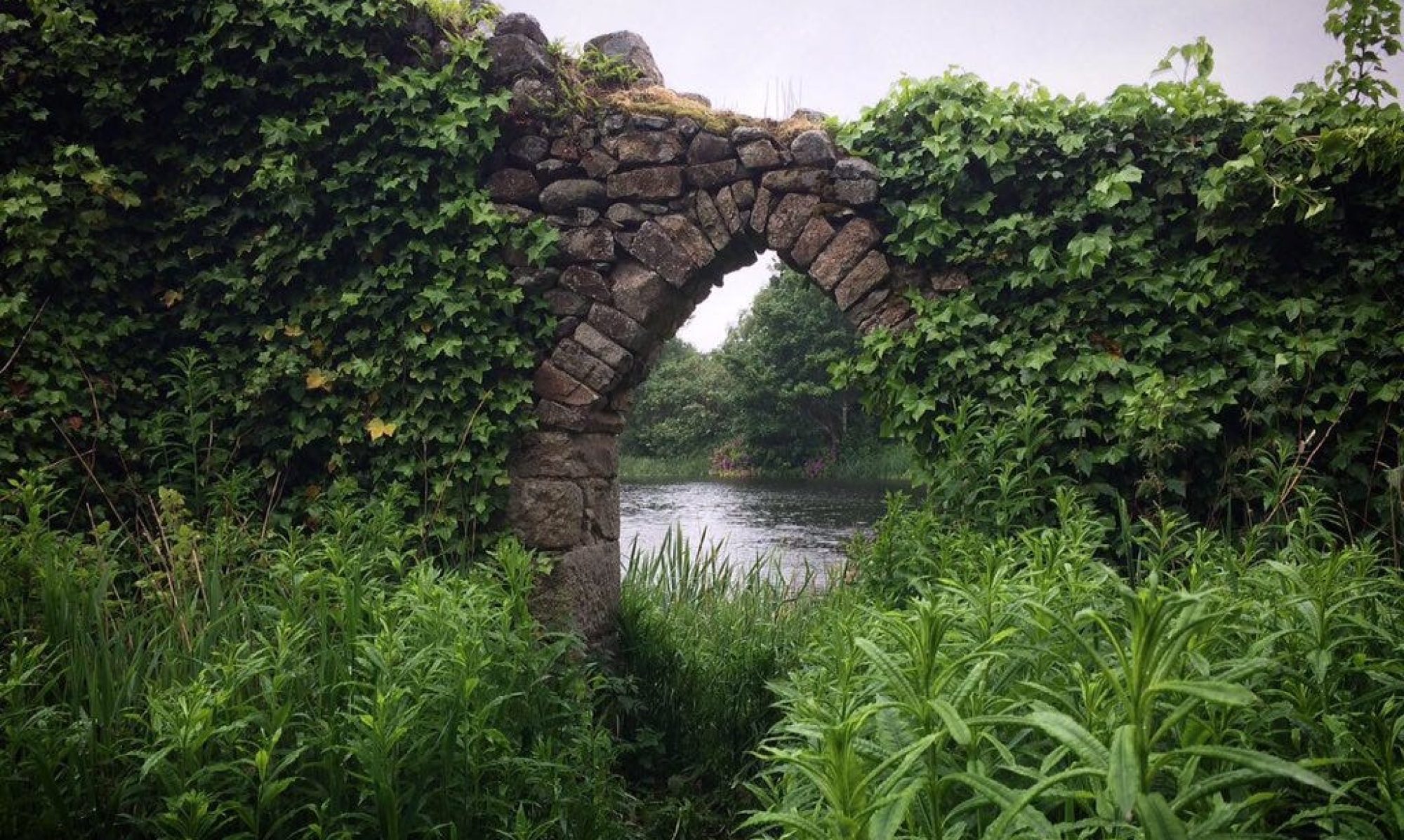
The term ‘blue mind’ describes the mild meditative state that we enter when in or close to natural bodies of water. It was coined by marine biologist Dr. Wallace J. Nichols. He wrote a book on the subject and did a Ted Talk too:
So ‘blue mind’ in mind, and encouraged by my wee trip to Rosehearty Harbour, I ventured out again. Travelling slightly further this time, I arrived at New Aberdour beach where everything was blue, blue, blue…
Blue Mind to Pink Rocks
Feet bare, I sat on the pink rocks and stared out to sea.
I saw stones and pools and pink, lots of pink everywhere.
I am just looking at the soft shapes of land, and the hard shapes of rock, as they drop away into the sea. No in-between places up on top here. No beach, no marsh. Here the space between life and death is painted clear. You could be walking on grass one moment and dead on the rocks the next. This is a place of instant transition from one state to another.
There’s more ‘blue mind’ photos in the older post Going Coastal.
Set in 1st century Northern Scotland, SISTERS AT THE EDGE OF THE WORLD is a story of chosen sisters, fierce warriors, divided loyalties and, ultimately, love. It features a neurodivergent main character, the battle of Mons Graupius between the Romans and the Caledonian tribes, and some rather complicated romance!
Go here to sign up for my occasional emails that always include exclusive photos and news of my writing and life. They’re a more intimate space than the blog. If you would like to hear about new books and offers, you can follow my Amazon author page.
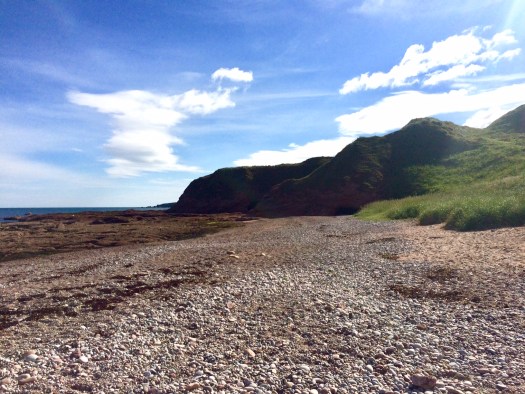
These days, you don’t have to catch a boat or ferry and can drive straight over the large Skye bridge. That’s the Old Man of Storr in the hills above, a beautiful rock formation visible for miles around. This post details a holiday I took with my family in 2017, before chronic illness put paid to such things as holidays. For now. I have to believe, for now. But enough of that, over the sea to Skye we go!
Dun Hallin
The island is a place of fairies: there’s a castle and a glen and a bridge, much smaller than the one taken to get to the island. But first, back to another rock formation, specifically the one spied from the bedroom window of our holiday house.
‘That’s an interesting rocky outcrop,’ said I to husband.
‘Aye, we should walk up to it,’ he replied.
So we did.
And there was Dun Hallin, an Iron Age broch we had intended visiting but thought would be hard to find. Duns, or brochs, were a complex form of roundhouse, probably defensive, precursors to castles.
I loved Dun Hallin and the surprise of finding it like that. And the wonderful views of Trumpan Point.
The Trial Stone
Trumpan Kirkyard held surprise too. An ancient standing stone, Clach Deuchainn, the Trial Stone:
Trial stones were used to try a person. In this case if the accused could put their finger in the hole located on the stone, while blindfold, they were innocent. The stone is undoubtedly far older than this use. It is also known as the Priest Stone and the Heaven Stone.
There were some interesting graves too; these, and the gruesome history of the church can be read about here.
Fairies
But back to the fairies. Firstly the Fairy Glen, an unusual land formation, which sadly does not have anyfolklore associated with it, but it does feel otherworldly when you walk round it.
The rocky peak is known as Castle Ewen:
It’s Dunvegan Castle that we need for fairy legends!
Displayed inside the castle, so no photos, is the ancient and tattered Fairy Flag. There are many stories and traditions surrounding this relic and its origins. The tale favoured in the information provided to visitors is the one in which the Chief of Clan Macleod marries a fairy. The couple have a child together but the fairy knows she has to return to her people in Fairyland. She leaves the magical flag, imbued with protective powers, wrapped round the baby, and this she does a few miles away at the Fairy Bridge:
There are also Fairy Pools on Skye but we did not get to them this trip. We did manage a quick visit to Kilt Rock:
We also took in the Museum of Island Life, one of the few places on the island with good mobile internet which meant I was distracted by a sudden barrage of Twitter notifications!
Near to the museum is the memorial to Flora MacDonald:
One more fairy mention: the house we stayed in was previously owned by the writer Aileen P. Roberts, and full of books, so I read her novella Fairy Fire while there, which was set in Skye and surprising and perfect.
The sun rises over Dun Hallin:
And sets at Trumpan Point:
We’ll be back over the sea to Skye again one day!
Newsletter
Go here to sign up for my (roughly monthly) newsletter. It’s a more intimate space than the blog and always includes some exclusive photos. If you would rather just hear about new books and offers, you can follow my Amazon author page.
My Books
Set in 1st century Scotland, my latest novel, SISTERS AT THE EDGE OF THE WORLD, includes the battle of Mons Graupius between the Romans and the Caledonian tribes. The book features a neurodivergent main character and some rather complicated romance!
Taking place mainly in a fictional castle, THE MERMAID AND THE BEAR blends an often overlooked period of history, the Scottish witchcraft accusations, in particular the 1597 Aberdeen witchcraft panic, with a love story.
FIREFLIES AND CHOCOLATE was inspired by the kidnapped children and young people of Aberdeen. The story follows the adventures of Elizabeth Manteith from the castle and her determined efforts to get back home. There’s love. There’s derring-dos on the high seas… And there’s chocolate!
From the misty hills of ancient Scotland emerges a tale of love, betrayal, and the fight for freedom. Join Morragh in SISTERS AT THE EDGE OF THE WORLD for an unforgettable journey.
Set in 1st century Scotland, the novel includes the battle of Mons Graupius between the Romans and the Caledonian tribes. There’s a neurodivergent main character and some rather complicated romance.
I love Loanhead of Daviot Stone Circle. Really love it. I know I’ve talked about how Aikey Brae is my favourite, and that is true. But this one comes in a close second. It’s another circle that I’ve been visiting for decades, often starting a day out with a quick walk round the stones.
A Wee Castle in the Woods
The approach is through woodland, and I like the wee castle that has appeared in recent years.
The path then leads up the hill and out to the stones.
Loanhead of Daviot Stone Circle
It’s a happy feeling circle, this one. They all have their own distinct atmosphere. Of course, maybe it’s just my own response to these places that I’m feeling. But then, isn’t everything that? A bit, at least. I once felt so happy at Daviot that I danced around in my bare feet and broke a toe on a hidden stone in the grass.
It always seems to be sunny there when I visit.
I picked up a fallen oak leaf from the adjacent ring of small stones that was used as a cremation cemetery in the distant past. The leaf is on my desk now as I write.
Daviot has been quite well excavated, with many cremation burials found (see the Historic Environment Scotland site). And there is, or was, a second circle across the valley. Only the large recumbent and flankers remain now. You can just make them out below, by the densest part of the tree line. You should be able to click the image to see a larger version.
We hold hands as we walk down and then up the short grassy valley that lies between the two circles. The stones we arrive at are overgrown with all manner of plant life. There are healing herbs that I recognise, wee flowers too, and spiny stems that look rather forbidding. Keep out, they say. Stay away. Leave the stones in peace.
And from Terry Tyler: “It’s a fabulous story, a real page-turner and so well written. It made me think about the passage and circle of time, of the constancy of the land on which we live and the transient nature of human life. Loved it.”
Set in 1st century Scotland, SISTERS AT THE EDGE OF THE WORLD includes the battle of Mons Graupius between the Romans and the Caledonian tribes. The book features a neurodivergent main character and some rather complicated romance…
An Autistic Dancer, a Byronic Hero and an Obsessive Scientist
Read my series A Dancer’s Journey. There’s ballet. There’s lots of naughtiness. And there’s peril!
Enjoy a kiss on the London tube in the first book, TENDU. Romp up and down the castle stairs. Dance in a stone circle. Attend a Ceilidh in the great hall. Have your brain studied in the dungeon. All fun, I assure you. Well, not quite all…
From emmalolly13 on TikTok: “This series has a special place in my heart… I feel so blessed to continue reading Amalphia’s story… Her journey with love has been rough… this is such a soul-touching series.”
Go here to sign up for occasional emails that always include exclusive photos and news of my writing and life. They’re a bit more intimate than the blog. If you would like to hear about new books and special offers, you can follow my Amazon author page.
A couple of years ago, I decided to look for the Hanging Stone near Rosehearty, here in Aberdeenshire. It’s a witch stone, a place of historical execution and, according to local folklore, ‘dooking’ as well.
I knew the stone was in the vicinity of the Mounthooly Doocot (pigeon house), pictured above and below, so headed there first.
*Experiences mild jealousy of past self, so gung-ho in the ability to just get up and go out.*
Turning 360 degrees, searching the skyline, the stone was finally spotted, embedded in a dry-stane dyke. That’s a dry-stone wall; there’s a great art and skill to building these traditional field boundaries.
I walked from the Mounthooly car park, along narrow roads and then up the field.
And there it was. The stone was quite tall, much taller than me, and wrapped round with barbed wire, which seemed somehow appropriate, given its dark past.
History of the Hanging Stone
The Hanging Stone is quite possibly an ancient standing stone which later came to be associated with execution. It’s very square. Carved that way, I think.
Nearby is ‘The Pit’, said to have been ‘for witches’ and to have been used for ‘dooking’. This was a practice that involved testing someone in water to see if they would sink or float, and thereby prove if they were a witch or not. I did not see The Pit, and, as I walked away, focused my attention on the great beauty of the ocean views.
Set in 1st century Scotland, and featuring the cliffs and caves of Cullykhan Bay, SISTERS AT THE EDGE OF THE WORLD includes the battle of Mons Graupius between the Romans and the Caledonian tribes. The book features a neurodivergent main character and some rather complicated romance…
A couple of miles from the town of Forres in Moray is a mound known as Macbeth’s Hillock. Local folklore tells us that this is where Macbeth met with the three witches from the play.
‘By the pricking of my thumbs, Something wicked this way comes.’ So pronounces the second witch in Macbeth, Act 4, scene 1.
The Three Witches
The theme of the three witches is echoed in more folklore from the surrounding area. There are two stones in Forres that are both associated with them.
The Sueno’s Stone
In its glass case
This is a 9th-10th century Picto-Scottish stone depicting an ancient battle (I like to think it’s Mons Graupius as featured in SISTERS AT THE EDGE OF THE WORLD, but this is very unlikely given how long ago that battle took place). The stone is 6.5 metres tall and also lays claim, in local legend, to be situated where Macbeth met the witches. They are said to have been captured inside the stone, and should it ever be broken, they will be released.
Battle sideCeltic Cross side
The Witches Stone
A rather more gruesome stone, and story, sits outside the police station on the main road in Forres. It has become a small shrine.
There were originally meant to be have been three stones marking the final resting places of three women who were executed for witchcraft. The one remaining stone is held together with a piece of metal.
Go here to sign up for occasional emails that always include some exclusive photos and news of my writing and life. They’re a more intimate space than the blog. If you would rather just hear about new books and offers, you can follow my Amazon author page.
This was the first time I’d ever been in this circle. It’s right beside farm buildings, and you have to ask permission to walk through the farmyard to the stones. There’s a great farm shop, so I shopped for local tatties and asked in there.
The circle had a wall and fence round it. No gate. I hoisted myself over these barricades and into the wilderness that surrounds the stones. It was rather lovely. Muted light. Pink granite everywhere. Trees that seemed to be the same colour as the stones.
The Bear
I noticed that one of the photos I’d taken had that paw print icon, indicating that Siri had spotted an animal. Thinking I’d maybe missed a farm cat, I clicked on it.
It looks like there may have been a few cases of mistaken identity!
Go here to sign up for my occasional emails that always include some exclusive photos and news of my writing and life. If you would like to hear about new books and offers, you can follow my Amazon author page.
Easter Aquorthies, also known as East Aquorthies, is sometimes described as a ‘show circle’ and recommended as a good first stone circle to visit. This is due to its near perfect condition and position: all stones are present and upright; the grass always seems to have been manicured to a close shave, and the views of the surrounding countryside are magnificent. It’s also very clearly signposted from the nearby town of Inverurie, making it easy to find and then park in its small car park.
Bennachie
The Mither Tap of Bennachie is apparent wherever you walk in and around the circle, looming majestic and large over your shoulder.
The Recumbent Stone
The recumbent stone is unusual in that it has extra supporting stones on the inner side. I wonder what led to this arrangement. Did it fall and crush someone, in Neolithic or Bronze Age times, causing new health and safety measures to be put in place? It is on a slope, so maybe it was just hard to make secure. I hope no one got crushed!
Name Origin
The name is thought to derive from Gaelic and means either ‘field of prayer’ or ‘field of the stone pillar’. Most of the stones are granite but one, below, is red jasper.
Leaving Easter Aquorthies…
There are numerous tales of people finding it hard to exit Easter Aquorthies stone circle. Some describe walking away as being like trying to wade through treacle and report feeling as if the circle wants to keep them there. There are also stories of enticing music coming from under the ground.
On the day I visited, I really didn’t want to leave. I would rather have stayed sitting in the sun with my back up against one of the recumbent flankers, staring out over Bennachie.
I knew the next circle on my list to visit was going to be contrastingly tricky to find. And it was. But that’s a post for another day (see Tyrebagger here).
Leave I did, reluctantly, and a little later than planned. I encountered no treacle or music… but I have been left with a strong desire to return. Soon.
These books are so naughty that I’m a little worried nobody will be able to look me in the face again after reading them. But not that worried. They’re heading out into the world anyway.
When dance student Amalphia Treadwell embarks on a secret relationship with her charismatic new teacher, she has no idea of the danger that lurks in his school in Scotland…
Set in 1st century Scotland, SISTERS AT THE EDGE OF THE WORLD includes the battle of Mons Graupius between the Romans and the Caledonian tribes. The book features chosen sisters, fierce warriors, a neurodivergent main character and some rather complicated romance.
Taking place mainly in a fictional castle, THE MERMAID AND THE BEAR blends an often overlooked period of history, the Scottish witchcraft accusations, in particular the 1597 Aberdeen witchcraft panic, with a love story. There’s also six chapters of medieval-style Christmas.
FIREFLIES AND CHOCOLATE was inspired by the kidnapped children and young people of Aberdeen. The story follows the adventures of Elizabeth Manteith from the castle, and her determined efforts to get back home. There’s love. There’s derring-dos on the high seas… And there’s chocolate!
Sign up to the mailing list for news about my life and writing, and some exclusive photos. If you would rather just hear about new books and offers, you can follow my Amazon author page.
That’s definitely not the real Stone of Scone above. It’s an ancient standing stone at Finlaggan on the Isle of Islay.
But is the official stone, the one pictured below, the real stone? See BBC article about this stone as it heads south to be used in the latest coronation.
History of the Real Stone of Scone
The Stone of Scone, or Stone of Destiny, was used in the inauguration of Scottish Kings for centuries. In 1296 the English King, Edward I, took the stone from Scotland and incorporated it as part of his new ‘Coronation Chair’. Or did he?
Fobbed Off and Spirited Off?
Early mentions of the stone describe it as black and shiny, polished and beautiful. It’s rumoured that Edward was fobbed off with a worthless rock that was actually a drain cover, while the real stone was spirited off and hidden safely away.
Finlaggan is a quiet and remote place. It’s easy to believe that it might hide secrets.
An archaeological dig there was abandoned when money ran out.
If the stone is at Finlaggan, I suspect it might be on the Council Island, the place of important discussions and decisions. Maybe the island was also the site of a few laughs about kingly bottoms sitting over what was actually a drain plug?
“In the vein of Lucy Holland’s Sistersong with the narrative style of Rena Rossner’s The Sisters of the Winter Wood, Sinclair’s novel centers on two sisters and is told from Morragh’s point of view. The prose is deeply personal to Morragh’s struggles.”
Sign up to the mailing list for news about my life and writing, and some exclusive photos. If you would rather just hear about new books and offers, you can follow my Amazon author page.
It’s no secret that I love stone circles and other old stony places. I visit them. A lot. I hug them. Quite a bit. And I write about them. Aikey Brae, above, is my absolute favourite. The circle in my books is loosely based on this one. I’ve blogged about it here in the snow and here after the trees were felled.
Today I’m sharing some older photos of ancient sites that I’ve not used before, so they may not be too perfect, but I hope they capture the spirit of these special places.
First, I’m going back in time, deep into the family-photo archives, and journeying out of Scotland to Wiltshire in England.
Avebury
The great henge of Avebury, a circle with a village built right in the middle of it, is another of my favourites.
West Kennet and Silbury
Nearby is West Kennet Long Barrow where I once found a candle burning (very naughty, such things could cause damage):
Across the road from the barrow is the mysterious Silbury Hill.
Aberdeenshire Stone Circles
We have a nice wee henge in Aberdeenshire too at Broomend of Crichie, and the shape of the stones really remind me of Avebury. As does the fact that there was once an avenue of stones leading to the circle.
And just down the river, in the old graveyard, is the Bass of Inverurie.
The Bass is a natural hill that has been shaped. It’s been home to a Motte and Bailey castle and there have been older worked flint objects found there too.
Did someone create a diminutive complex similar to that of Avebury? I wonder…
Some lovely Pictish stones stand beside the Bass today, un-huggable in their new glass case.
The countryside of the Inverurie area is rich in standing stones and circles too. Easter Aquorthies lies a couple of miles away from the Bass. I’ve blogged about it here.
And, not too far away, is Loanhead of Daviot Recumbent Stone Circle, one that I’m writing about just now as it plays a part in the story of SISTERS.
At Daviot:
Wonderful Blogs
The Wee Writing Lassie asked me 7 intrusive questions! Go to her blog to see them.
Sally Cronin reviewed FIREFLIES AND CHOCOLATE on her wonderful Smorgasbord Blog Magazine: “This book is well researched, bringing history to life and the writing flows smoothly like hot chocolate as it warms on a cold day. It is a coming of age and love story which will have you holding your breath on occasion as Elizabeth comes to terms with her future.” See the whole review here.
Tyrebagger Circle near Aberdeen
Newsletter
I hope you’ve enjoyed my wee journey into the ancient past. Go here to sign up for my occasional emails that always include some exclusive photos and news of my writing and life. If you would rather just hear about new books and offers, you can follow my Amazon author page.
Books (stone circle included!)
Set in 1st century Scotland, my latest novel, SISTERS AT THE EDGE OF THE WORLD, includes the battle of Mons Graupius between the Romans and the Caledonian tribes. The book features a neurodivergent main character and some rather complicated romance!
Taking place mainly in a fictional castle, THE MERMAID AND THE BEAR blends an often overlooked period of history, the Scottish witchcraft accusations, in particular the 1597 Aberdeen witchcraft panic, with a love story.
FIREFLIES AND CHOCOLATE was inspired by the kidnapped children and young people of Aberdeen. The story follows the adventures of Elizabeth Manteith from the castle and her determined efforts to get back home. There’s love. There’s derring-dos on the high seas… And there’s chocolate!