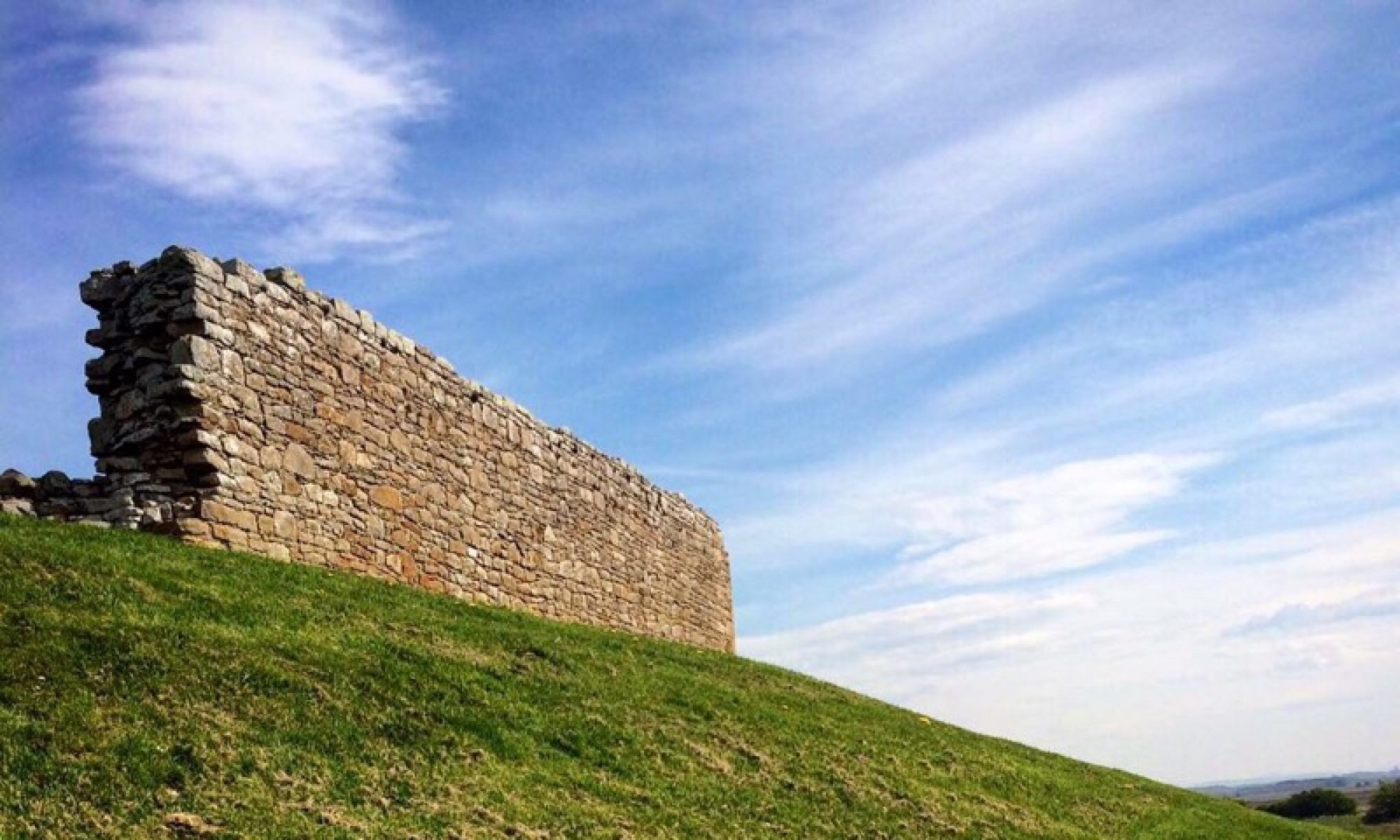
I had hoped it might be sunny on my recent visit to Bow Fiddle Rock, a natural sea arch near Portknockie. It was. Very briefly. Between the car and the benches, the sun shone brightly for a few seconds.
Then the clouds closed over, but the place was still beautiful.
Swan Lake
I was reminded of the stunning Swan Lake photos of husband and wife Gillian Murphy and Ethan Stiefel, taken by photographer Fabrizio Ferri below. Overcast, wet weather did not stop beauty there either.
Back at Bow Fiddle Rock, I slipped and slid over recently rained-on pebbles to take my photos.
I stopped to admire red clover on my way back up the cliff. And that was beautiful too.
Sisters at the Edge of the World
Set in 1st century Scotland, SISTERS AT THE EDGE OF THE WORLD includes the battle of Mons Graupius between the Romans and the Caledonian tribes. The book features a neurodivergent main character and some rather complicated romance…
Go here to sign up for my occasional emails that always include some exclusive photos and news of my writing and life. If you would rather just hear about new books and offers, you can follow my Amazon author page.
Bessie had shown me the great hall, a huge room that put one in mind of a church. Sunlight fell through twelve windows, making narrow shapes on the earthen floor of that place…
I did rather fill up my writer’s swag bag at Drum.
Below is a beautiful bedpost…
Chapter 34:
“It’s beautiful, Thomas,” I said, walking into the room and running my hands up and down the dark smooth wood of the bedposts which were swirled with infinite oak leaves.
I don’t have a good picture of the dungeon there, though I pilfered that too. It’s a terrible place with a narrow stairway leading down, down, down into the dank. However, bats were roosting in it the last couple of times I visited the castle, and they’re a protected species so it was absolutely forbidden to disturb them. Which was quite a relief really…
Here is a pictorial quote from the book:
And into the swagbag goes…
A forest view from a high window at Crathes Castle
From Chapter 38:
I sat up on my seat by the three thin windows and watched the first golden shafts of morning light creep over the tops of the trees in the forest.
A Secret Stairway
From beautiful Craigievar I took the secret stairway that runs from top to bottom of the castle, strictly no photos allowed inside…
From Chapter 28:
We were in another passage, small and stony and grey, and after a short way it led to a narrow stairwell that was not lit by torches and sconces like the big one, but dark and shadowy and hidden. Secret. Indeed safe. For now.
The Laird’s Lug
Castle Fraser gave me its triangular peep-hole and ‘Laird’s Lug’.
From Chapter 28:
I told the Laird, and he took his turn at the peephole and gave the scene a long assessing look. “It is a pity there is so much noise tonight; we could have made out their words otherwise, the walls of the lug are thinned in places and shaped to augment speech made in the hall.”
I think that’s enough of my rampant thievery for one post – there may be others – so I’ll leave you with this review of the book from Terry Tyler, a brilliant writer herself. Actually – I can’t help myself – I’ll just steal a quote from that too:
Ailish Sinclair’s portrayal of 16th century, wild rural Scotland is quite magical. On one recent evening I was curled up in bed, head on cushions and lights dimmed, and I found that I was revelling in every description of the countryside, the day-to-day life at the castle (particularly the Christmas revellry; this made me long to be in the book myself!), the suggestion of ancient spirituality, and the hopes and dreams of the characters. Suddenly I realised that I’d gone from thinking ‘yes, this is a pleasant enough, easy-read’ to ‘I’m loving this’.
And here’s a wee picture of my author copies, or castle swag bags, if you will. Buy your own here on Amazon in paperback or on Kindle.
Scotland’s all misty lochs and magical forests and perfect boyfriends, right?
When dance student Amalphia Treadwell embarks on a secret relationship with her charismatic new teacher, she has no idea of the danger that lurks in his school in Scotland…
My dance background and love of history and spicy stories are what inspired this heady mix of contemporary romance and ballet set in a castle. Readers of my historical fiction will recognise the castle and stone circle that feature in these books.
Keep up to date with all my news by signing up to the mailing list. It’s a more intimate space than the blog and always contains some exclusive photos. If you would like to hear about new books and offers, you can follow my Amazon author page.
Burghead Pictish Fort was built around 400 CE and destroyed by fire a few centuries later. The fort was large and must have been a centre of power and significance to the Picts. It was raided by the Vikings more than once, and in 884 CE it was captured by Sigurd the Powerful, the Earl of Orkney.
The Picts
The Picts were a group of peoples probably descended from the Caledonii tribe and other Northern tribes (as featured in Sisters at the Edge of the World). The term ‘Pict’ was used by the Romans from the 3rd century CE to describe the people of what is now Scotland.
The Pictish gentleman above stands by a stone from the original rampart of the fort in the modern-day visitor centre. Below is a depiction of how Burghead would have been in its heyday.
Burning of the Clavie
I attended the ancient fire festival of the Burning of the Clavie a few years ago. It takes place in Burghead every January 11th, on the old Scottish new year. The origins of the festival are unknown, though I suspect it may have something to do with the aforementioned Vikings!
A group of men carry a barrel of tar and staves (the clavie) around the village, followed by a great crowd. When I was there, petrol was then flung onto the clavie, creating large explosions of fire, after which it was left to burn out up at the fort. The pubs in Burghead serve free food on Clavie night.
The Remains of Burghead Pictish Fort
Sadly, most of the fort stonework was destroyed when the village of Burghead was built in the 19th century. People do sometimes find parts of it in their gardens. The ancient well remains, and I visited it: see the post here
Burghead is the only Pictish site where Bull Stones have been found. There were at least thirty, though many have gone missing over the years.
The sea views are amazing, and though all is peaceful at Burghead today, it’s easy to picture Viking boats approaching… Note the wee swallow flying by in the photo below.
Dive into the rich history of ancient Scotland with “Sisters at the Edge of the World,” a tale of sisterhood, sacrifice, and the struggle for freedom against Roman occupation.
Go here to sign up for my occasional emails that always include some exclusive photos and news of my writing and life. If you would like to hear about new books and offers, you can follow my Amazon author page.
I mentioned the Wine Tower, Fraserburgh’s oldest building, in a previous post here along with the associated ghost story. It was also one of the 10 Mystical and Magical Sites in Aberdeenshire that I wrote about for the official tourism site of Aberdeen and Aberdeenshire.
Inside the Wine Tower
Through the door we go…
During one Doors Open Day, the tower was, indeed, open, and I finally got to have a look at the interior.
There was no humming and hawing from the guide as there sometimes is in official written histories of the place. The topmost room of the wine tower was a 16th century (post Reformation) Catholic Chapel owned by the Frasers of the nearby castle (now a lighthouse musuem).
The carving you can see above depicts Christ’s hands and feet. The one below is the Fraser crest, held by an ostrich.
There seems to have been little exploration of the two lower rooms. There was no information available on them anyway. The middle one can only be reached via this hatch in the floor:
Castle Kitchens
The old castle kitchens were also open for dark and creepy viewing.
Sunset
Let’s end on an autumnal painted sky over the loch.
My Historical Fiction
These novels combine little-known dark events with love stories and a hint of magic.
Sign up to the mailing list for news about my life and writing, and some exclusive photos. If you would like to hear about new books and offers, you can follow my Amazon author page.
I walked past the sign to Strichen Stone Circle on my road to winter journey on Saturday. That’s actually as close as I got to the stones. It was just a wee trip out.
Strichen Stone Circle
I’ve been many times before, though, so here we go.
Every time I’ve visited this site, it’s been a dull day. But the stones are still majestic and bold.
This circle was knocked down in the 19th century, then put back in the wrong place, then built into a folly, then excavated, and finally placed back in its original position in 1982.
The recumbent looks like it may have been used for something at some point, to hold a post possibly?
You can see the old burnt-out Strichen House from the circle.
Set in 1st century Scotland, the novel includes the battle of Mons Graupius between the Romans and the Caledonian tribes. The story features a neurodivergent main character and some rather complicated romance…
Elizabeth Felt, a lecturer in English at the University of Wisconsin, had this to say about it: “The tone of this book is amazing. At the beginning, the narrator is mute, and the book feels so quiet, so in touch with the earth and stone and air and water… Amazing writing. Excellent story. Highly recommend.” See the whole review here.
Sign up to the mailing list for news about my life and writing, and some exclusive photos. If you would rather just hear about new books and special offers, you can follow my Amazon author page.
Tyrebagger Recumbent Stone Circle is near Aberdeen, situated on the hill behind the airport and overlooking the Kirkhill Industrial Estate.
The search for Tyrebagger
So, when my family and I went seeking this circle we thought it would be easy to find. Yes. Well. Google maps took us close. Very close in fact. But there’s nowhere to stop a car and get out on the dual carriageway, so no possibility of taking the app’s advice to ‘walk the rest of the way to your destination.’
We turned to directions found on the internet which took us up the side of the industrial estate and into the woods. But the last instruction, to turn right along the line of trees… there was no right there. We ended up lost and peering over gates and up tracks and across fields. But then, Google maps pinpointed the exact location of the stones and we retraced our steps.
‘”It’s somewhere in that direction…”
“Just the other side of those trees…”
“But how can we get through there?”
Until:
A circle, found!
A pathway was spotted – it had been there after all, but on the LEFT – and it had a certain look and feel about it. It reminded me of the path into the often elusive Loudon Wood circle. Sure enough, moments later the stones came into view over a gate and field, silhouetted against a misty looking forest.
Tyrebagger Stone Circle proved well worth the search.
It’s a beautiful circle, with unusually tall stones.
Outlander
Sometimes when I post stone circle photos on social media, people ask if they are the stones from Outlander, and I explain that those are fictional stones. But these do look a little like the ones used in the TV show. (Inverness Outlanders found another site that may be even more like it and have photographed it in all seasons here.)
I had heard that, due to its close proximity to Aberdeen, Tyrebagger sometimes has a graffiti problem. This was not the case on the day we visited. The stones stood tall and unblemished against the blue sky.
I liked the trees too, grey and tall like the stones.
“This carefully researched story is based on true events in Aberdeen when cruel men gained power over innocent women by accusing them of witchcraft. It is a horrifying story from our history, mirrored in other parts of the United Kingdom. Thankfully in The Mermaid and the Bear the sadness is tempered by love and kinship in a believable and satisfying conclusion. An enchanting novel.“
Let’s finish with one last look at Tyrebagger…
A Dancer’s Journey – a contemporary series
These books are so naughty that I’m a little worried nobody will be able to look me in the face again after reading them. But not that worried. They’re heading out into the world anyway.
When dance student Amalphia Treadwell embarks on a secret relationship with her charismatic new teacher, she has no idea of the danger that lurks in his school in Scotland…
Keep up to date with all my news, leafy and otherwise, by signing up to the mailing list. It’s a more intimate space than the blog and always contains some exclusive photos. If you would like to hear about new books and offers, you can follow my Amazon author page.
Is it possible to write a coherent novel when the primary research source, that I’ve become so deeply embroiled in, is anything but coherent? And how was that for a non-coherent sentence?
The witchcraft confessions of Isobel Gowdie are extraordinary. And strange. And mixed up in many ways, so it seems to me.
Here’s a quote from Confession 2, not translated by me, slightly translated by Robert Pitcairn in his 1833 work Ancient Criminal Trials in Scotland (I will translate quotes that appear in the novel for ease of understanding):
“The aucht Spirit [is called] ‘ RoBERT The JAcks,’ ftill clothed in dune, and feimes to be aiged. He is ane glaiked gowked Spirit! The woman’s [nikname] that he waitis on, is ‘ABLE AND STOWT!'”
The letter S was written as F. Sometimes. The letter F was also written as F. All the time. What a wonderful voice Isobel had, for I definitely feel that at least some of that passage did not come from just answering ‘aye’ to closed, specific questions. Such are my incoherent, and sometimes inconsequential, thoughts…
I also revisit the Downie Hillock, where Isobel dined with the King and Queen of Elfhame (fairyland). It’s nice there.
I was there in these places on May 3rd, the day on which, in 1662, Isobel gave her second confession.
Back at my desk, I remember that coherence can come in editing. Later. And I let the words and the story flow on…
The Mermaid and the Bear, 2019
Everyone knows about the Salem witch trials that took place in seventeenth century America, but less well known are the instances of witch hunting that occurred across Scotland.
Ailish Sinclair painstakingly researched this fascinating and terrible subject for more than a year, before blending it with a love story in her debut novel, THE MERMAID AND THE BEAR. Featuring three real women who were accused as part of the Aberdeen witchcraft panic of 1597, the book is set against the beautiful backdrop of the Aberdeenshire countryside and tells the story of Isobell, and her desperation to escape London and an arranged marriage, to find a better life.
Upon landing in Scotland, Isobell’s dreams of faery castles, ancient woodlands and misty lochs seem to be coming true, as she finds herself kitchen maid to a handsome Laird, who offers not only safety but also the hope for a brighter future, filled with love and kindness. All is not how it seems, however, and enemies, both from the past and the present, conspire to test Isobell to the limits of endurance, and beyond.
If you want to be kept updated about when new books are available, you can sign up for the mailing list (lots of photos there too), or follow my Amazon author page.
Gight Castle may be one of the lesser known castles of Aberdeenshire, but it has a rich, if somewhat bleak, history with many of its owners dying prematurely. Built in the 15th century by the Gordon family, it’s the ancestral home of Lord Byron. A ghostly piper is said to haunt the ruins. The nearby Hagberry Pot in the River Ythan is said to be bottomless and full of treasure!
Walking Around Gight Castle
The quines took a walk. We started in Methlick and strolled through the Braes of Gight woods, across fields and along roads. This was the long way to do it: there is a car park relatively near to the castle. First view:
The castle was surrounded by barbed wire and there were ‘enter at your own risk’ signs.
In we went:
Great windows:
We were careful not to wake Sleeping Beauty. Or the ghostly piper.
I was most impressed by this brave little tree:
Hagberry Pot
Then, taking the circular route, we headed off down to the river and tried to work out which bit was the Hagberry Pot. Nowhere looked very bottomless or a good hiding place for jewels, but this seemed the most likely site by the bridge:
The 7th Laird of Gight threw his jewels in there when the castle was sacked by the Covenanters. The poor diver who was sent down to retrieve them floated back up to the top in four pieces. There is a more involved version of this story here, featuring the devil. We did not go in.
The walk back along the river was pleasant, if a bit boggy, with glimpses of the Castle up on the hill.
Newsletter
Sign up to the mailing list for news about my life and writing, a free story and some exclusive photos. If you would like to hear about new books and offers, you can follow my Amazon author page.
SISTERS AT THE EDGE OF THE WORLD
Set in 1st century Scotland, SISTERS AT THE EDGE OF THE WORLD includes the battle of Mons Graupius between the Romans and the Caledonian tribes. The book features a neurodivergent main character and some rather complicated romance…
Taking place mainly in a fictional castle, THE MERMAID AND THE BEAR blends an often overlooked period of history, the Scottish witchcraft accusations, in particular the 1597 Aberdeen witchcraft panic, with a love story. There’s 6 chapters of medieval Christmas too.
FIREFLIES AND CHOCOLATE was inspired by the 600 children and young people who were kidnapped from Aberdeen during the 1740s and sold into indentured servitude in the American Colonies. The story follows the adventures of Elizabeth Manteith from the castle and her determined efforts to get back home. There’s love. There’s proper derring-dos on the high seas… and there’s chocolate!
Duffus Castle looms, majestic and huge against the skyline as you approach. It’s imposing and impressive… dramatic too…
Duffus Castle at Easter
On the day I visited – Easter Sunday – it was busy, really busy, and the air contained a mysterious hint of sulphur. This medieval fortress of the Moray family, one of Scotland’s most beautiful motte and bailey castles, had become a giant playground for the seasonal pastime of ‘egg rolling’.
They’re Not Daisies
You see those white bits in the grass in the photo above that look like daisies? Not daisies. Everywhere, the ground was strewn with smashed boiled eggs, as people, both old and young, hurled them with great gusto from the top of the ramparts.
I recall rolling eggs sedately down a gentle slope on Easter Sunday when I was a child. Then, once your egg was cracked, you peeled and ate it, despite the fact that the colour from your decorating efforts had soaked through the porous shell and onto the egg white.
No one was eating their eggs at Duffus Castle. The goal was definitely to throw them as far as possible. A bit like shot put. Or the Scottish sport of tossing the caber. And you know what? It wasn’t entirely unfitting. There was something medieval and combative about it. Risk was in the air and on the ground; you could be hit by, or step on, an eggy missile at any moment.
Down on the Moat Path
It was quieter on the moat-side walk, though one or two eggs had somehow found their way down there too. The path offered some of the prettiest views of the castle and the remains of its walls.
I tiptoed round shells, yolks and egg whites, inside the old keep too.
The Privy Chamber
As I look at the photo of the fallen privy chamber below, I am actually still thinking about the eggs. Who cleans them all up? There were large mounds of them, warming in the sun, at the foot of the ramparts. I imagine the circling seagulls swoop down and help themselves once the crowds have gone. But some poor person, presumably a member of Historic Scotland‘s staff, must be stuck with the task of clearing it all away properly? I hope they get given a large Easter egg to make up for it. Or perhaps a chocolate bunny would be less galling…
Newsletter
Sign up to the mailing list for news about my life and writing, and some exclusive photos. If you would rather just hear about new books and offers, you can follow my Amazon author page.
SISTERS AT THE EDGE OF THE WORLD
Set in 1st century Scotland, SISTERS AT THE EDGE OF THE WORLD includes the battle of Mons Graupius between the Romans and the Caledonian tribes. The book features a neurodivergent main character and some rather complicated romance!
Taking place mainly in a fictional castle, THE MERMAID AND THE BEAR blends an often overlooked period of history, the Scottish witchcraft accusations, in particular the 1597 Aberdeen witchcraft panic, with a love story. There’s 6 chapters of medieval Christmas too.
FIREFLIES AND CHOCOLATE was inspired by the 600 children and young people who were kidnapped from Aberdeen during the 1740s and sold into indentured servitude in the American Colonies. The story follows the adventures of Elizabeth Manteith from the castle and her determined efforts to get back home. There’s love. There’s proper derring-dos on the high seas… and there’s chocolate!