Bring your cloots! And let’s go make a wish at the Clootie Well on the Black Isle.
The Black Isle
The Black Isle is a peninsula near Inverness in The Highlands of Scotland. The towns and villages of the ‘Isle’ boast many excellent museums, hotels and shops. There are castles too, making the quick drive over the Kessock Bridge well worthwhile. Dismantled oil rigs can sometimes be seen on the Cromarty Firth side, as can dolphins.
Searching for the Clootie Well
Inland there are older places, special places.
We take a wrong turn while searching for the clootie well, an ancient, possibly Celtic, shrine, and then spend some time wandering among trees.
Ah Ha! We’re on the right track now.
People hang cloots (cloths) beside the well and in the surrounding woodland to ask for wishes or healing. As the cloot disintegrates, healing occurs or wishes come true.
It’s an unusual but peaceful place. Despite the modernity of many of the hanging items, the well feels timeless. The number and variety of cloots is impressive. They extend right down the hill to the roadside.
I tear a small piece of fabric from the bottom of my dress and tie it to a smaller branch of the tree above to thank the spirit. She needs it not, but it is a mark to me, a sign of my reverence, and a reminder of the blessing received on this day.
Set in 1st century Scotland, my latest novel, SISTERS AT THE EDGE OF THE WORLD, includes the battle of Mons Graupius between the Romans and the Caledonian tribes. The book features a neurodivergent main character and some rather complicated romance!
I prance up the pirate steps, and I dance down the other side.
Pirate Steps
Folklore tells us that pirates and smugglers were not permitted to pass through the gates of a kirkyard, but they were allowed to attend church, hence the special stairway.
These particular steps are located in the surrounding wall of St. Mary’s Chapel in Rattray, Aberdeenshire. The chapel is one of the oldest structures still standing in the area, and it’s rather beautiful.
I ran up and down similar steps at Kildaton on Islay but, sadly, I do not have any photos of them.
Rattray steps and gate:
TikTok Fun
In other news, my current medication is keeping me up at night. It’s rather like living in several different time zones at once. I’ve been amusing myself by playing on TikTok and YouTube.
Naughty Contemporary Fiction
Scotland’s all misty lochs and magical forests and perfect boyfriends, right?
When dance student Amalphia Treadwell embarks on a secret relationship with her charismatic new teacher, she has no idea of the danger that lurks in his school in Scotland…
My dance background and love of history and spicy stories are what inspired this dark mix of contemporary romance and ballet set in a castle. Readers of my historical fiction will recognise the castle and stone circle that feature in these books.
A Dancer’s Journey is available in paperback, Kindle and on Kindle Unlimited.
There are no cliffhanger endings in this series; each book completes a story, but then there is more. So much more. Read all the blurbs here
Historical Fiction
These novels combine little-known dark events with love stories and a hint of magic.
Sign up to the mailing list for news about my life and writing, and some exclusive photos. If you would like to hear about new books and offers, you can follow my Amazon author page.
Crows nest in the old keep of Pitsligo Castle near the village of Rosehearty in Aberdeenshire. Dating from 1424, it’s an impressive and atmospheric place. The Forbes family who built it, staunch Jacobite supporters, lost their lands and titles after the battle of Culloden. The castle was then ravaged by Hanoverian soldiers and fell into ruin.
The oldest part of the castle, the keep or tower:
Many of the rooms round the rubble filled courtyard remain intact. The evening sun added bright effects on this visit.
A large bird flew out of here. It was all a bit ‘Game of Thrones’…
Here and there the sky shows through chimneys, windows and decayed stairwells.
The gateway:
Peathill Kirk
Just up the hill sits Peathill Kirk, where old and new towers stand side by side and, unsightly as it is, mobile phone reception is great.
Ghosts of Jacobites lurk here too.
Alexander Forbes, the 4th Lord of Pitsligo, quite a famous Jacobite, and owner of Pitsligo Castle, is buried in the crypt below. He was a most interesting character.
The two sites make a trip up to Peathill most worthwhile. The castle and kirk would been used and inhabited at the same time – Lord Pitsligo would have sat in the Forbes pew just above where his grave now is – and offer an evocative glimpse into the past.
Chosen Sisters, Romans and Romance
Set in 1st century Scotland, SISTERS AT THE EDGE OF THE WORLD includes the battle of Mons Graupius between the Romans and the Caledonian tribes. The book features a neurodivergent main character and some rather complicated romance.
Review from Terry Tyler: “It’s a fabulous story, a real page-turner and so well written. It made me think about the passage and circle of time, of the constancy of the land on which we live and the transient nature of human life. Loved it.“
Taking place mainly in a fictional castle, THE MERMAID AND THE BEAR blends an often overlooked period of history, the Scottish witchcraft accusations, in particular the 1597 Aberdeen witchcraft panic, with a love story.
FIREFLIES AND CHOCOLATE was inspired by the kidnapped children and young people of Aberdeen. The story follows the adventures of Elizabeth Manteith from the castle and her determined efforts to get back home. There’s love. There’s derring-dos on the high seas… And there’s chocolate!
Go here to sign up for occasional emails that always include exclusive photos and news of my writing and life. They’re a more intimate space than the blog.
You can now go up on the roof of the newly done-up Aberdeen Art Gallery. It’s quite nice up there among the green domes of the city. That’s the theatre straight ahead and Union Terrace Gardens (also going through the process of change) to the left.
Arriving on the roof of Aberdeen Art Gallery
I was relieved to arrive up on the roof during my recent visit. I’d displayed distinctly codger-like tendencies until then. Where were the old marble stairs? Why were there new plastic-covered ones instead? How was that an improvement? And what about the fountain and the thing that used to be in the middle of it?
Works of Art
‘The thing’ was on the roof, and I was glad to see it.
Oval Form – Trezion Dame Barbara Hepworth
There were other old favourites throughout the gallery too, and photography was allowed everywhere.
Penelope, her milkshake bringing all the boys to the yard:
Penelope and the Suitors John William Waterhouse
A lit-up love poem:
For You Tracey Emin
Then there was a buttery, a local delicacy, a sort of salty, fatty squashed roll. Unfortunately, I did not note the name of the artist.
The Kirk of St Nicholas could be seen from the roof of the gallery. I do seem to see it wherever I go in the city.
I wandered down to the kirkyard before leaving Aberdeen. The grass had obviously not been cut all season, giving the place an unkempt and uncared-for feel. There was a poppy, though. And that was beautiful.
People accused of witchcraft were imprisoned in the old steeple of that kirk long ago, as mentioned in THE MERMAID AND THE BEAR.
Taking place mainly in a castle, THE MERMAID AND THE BEAR blends an often overlooked period of history, the Scottish witchcraft accusations, in particular the 1597 Aberdeen witchcraft panic, with a love story.
Go here to sign up for my occasional emails that always include some exclusive photos and news of my writing and life. If you would rather just hear about new books and offers, you can follow my Amazon author page.
I’ve written about Lord Pitsligo before, briefly here in a post about his home, Pitsligo Castle, and then in more detail over at The Witch, The Weird and the Wonderful. He’s an intriguing character who hid around the Buchan countryside for three years following the battle of Culloden, for some of the time in a cave which is still referred to as Lord Pitsligo’s Cave.
I had to find it.
Walking to Lord Pitsligo’s Cave
A friend and I set off along the coast, heading West from Rosehearty, having read several conflicting accounts of the exact location of the cave. We knew it had been blown up by the home guard in WW2 and the lower entrance made inaccessible. Perhaps the best we would be able to say was that we’d walked near it?
We passed lines of white quartz and rocky plateaus and many craggy cliffs where we stopped and wondered: is this it?
Then: yes! We just knew we’d found the place. Seagulls flew up, angry about us being so close to their nests, but down we went into the bay.
It’s not too easy to discern in my shadowy pictures, but there’s a pile of rubble where the lower entrance would have been and a small opening in the cliff above.
My friend went back on a brighter day and zoomed in on the higher entrance:
We walked further, along to Quarry Head, the site of a 16th century shipwreck (interesting story here), and looked back across the various bays:
It’s a stunning bit of coastline to explore; the cave is about two miles from Rosehearty. Picture below taken on another day just before a thunder storm, note the tiny white sailing boat in the centre:
My Books
My newest book features another local cave, by Cullykhan Bay.
Set in 1st century Scotland, SISTERS AT THE EDGE OF THE WORLD includes the battle of Mons Graupius between the Romans and the Caledonian tribes. The book features a neurodivergent main character and some rather complicated romance…
All my books are available in paperback and kindle and can be seen on my Amazon Author Page. If you follow me there you should be updated with new releases and any offers or sales.
Newsletter
Go here to sign up for my (roughly monthly) newsletter. It’s a more intimate space than the blog and always includes some exclusive photos.
This ‘writing a monster’ post was originally posted in 2020. I’m doing much better now, though still writing and researching those historical monsters!
Being a Monster
I don’t need a Halloween costume this year (2020). I already look like a monster. The medication I’m on to stop my body killing me (condition lamented here) has made my face swell up. Like a moon. It is a well documented side effect actually referred to as ‘moonface’. The same drug is also causing insomnia, so I have massive eye bags that extend to what feels like halfway down my face. There’s quite a lot of bandage action across my body too, which adds an air of mummification fun to the whole ensemble.
I’m also pale. Pale like a ghost.
Writing a Monster
However, being a monster on the outside, in appearance, is nothing to being truly monstrous. While researching witch-hunting in preparation for writing THE MERMAID AND THE BEAR, I wanted to find a real monster, a person so enthused for the brutal activity that they could become a focal point for that dark energy in the story. History did not give him up easily. There was no obvious individual in the court documents or confessions. But I hunted him down and finally cornered the rogue in the financial accounts of Aberdeen.
In September 1597 William Dunn, Dean of Guild, was awarded, £47 3s 4d (the equivalent of £6000 in today’s money) for taking ‘extraordinary pains in the burning of a great number of witches’. It was unusual for someone to be given a large lump sum like this. With the exception of some witch prickers and those who sought to escheat their rich relatives, money was not commonly a motivating factor in the witch trials. William Dunn’s job was being in charge of the public money of the town, so he basically gave the cash to himself. I found you, Sir, and I made you smell of rotten fish! If you read the historical notes section of the book, you’ll see that I’ve also cast him as a metaphorical, though very real, devil.
Bandage action!
So now I’m editing FIREFLIES AND CHOCOLATE and, 150 years later, there is brief mention of the Dean of Guild again. It does seem to be a role associated with making money from the suffering of others, at least, historically, in Aberdeen. And, again, I am writing a monster.
Mermaid Review
There’s a review I forgot to mention earlier, being rather distracted by the task of becoming a monster. It’s from Undiscovered Scotland: “The Mermaid and the Bear is a delight from end to end. There is a superb level of description in the book, that transports the reader back to the sights, sounds and smells of 16th Century life in a Scottish castle.” See the whole review here.
A spooky wee quote for this spooky old season:
Chosen Sisters, Romans and Romance
Set in 1st century Scotland, my latest book, SISTERS AT THE EDGE OF THE WORLD, includes the battle of Mons Graupius between the Romans and the Caledonian tribes. The book features a neurodivergent main character and some rather complicated romance.
Review from Terry Tyler: “It’s a fabulous story, a real page-turner and so well written. It made me think about the passage and circle of time, of the constancy of the land on which we live and the transient nature of human life. Loved it.“
That’s the Sea Gate at Eilean Donan Castle, in the Highlands of Scotland, above. It’s two things at once. In the present day, it’s beautiful. But it’s said that people used to be thrown out of it, in acts of punishment or coercion. So, it’s terrible too. Sad, even.
And it’s the same with writing stories. Yes, they can be sad, and dark, and terrible. But they’re not only that. Or they don’t have to be. As with many things, in writing or life, it’s all about how it’s done.
A view from Eilean Donan Castle
Writing Sad Stories
It was a recent review of FIREFLIES AND CHOCOLATE that got me thinking about this. Here’s the pertinent part of what the reviewer said:
I was somewhat hesitant to read this novel as I thought it would be too sad, but was glad to have chosen to read it as Sinclair did not disappoint with the telling of an exceptionally satisfying tale.
I felt the exact same hesitancy about writing the book. It was while researching local history for THE MERMAID AND THE BEAR that I stumbled across the information that 600 children and young people had been kidnapped from Aberdeen during the 1740s. They’d then been transported to the American colonies where they were sold into indentured servitude. It was terrible. It was sad. And, almost totally, overlooked. It wasn’t history that got talked about much. In fact, most people knew nothing about it. So, it was precisely the sort of story, sad or otherwise, that I liked to tell.
A photo taken somewhere between Glen Shiel and Eilean Donan Castle
Making Historical Characters Relatable
I wanted to bring those people from the past to life, to make them human and relatable. But, wouldn’t it be too depressing to open the door to those particular historical events?
The castle door…
The answer is: no. I don’t think so, anyway. I found the book great fun to write. In fact, I think it’s the least dark of my novels. The main character, Elizabeth, is so determined, and so easily enraged. She kicks sadness to the side. Mostly. She does have some despairing moments. I wrote about one of those times in response to a question on the Wee Writing Lassie Blog (see the whole interview here):
A young girl was found dead in First Mate Alexander Young’s bunk during the voyage from Aberdeen to America. History has not recorded her name so I called her Maggie, and her death has a deep impact on Elizabeth in several ways. It causes her terrible grief, informs her opinions of what ‘fine gentlemen’ can actually be, and provides a specific awareness of how much danger she and other women and girls are in at times.
The publisher had this to say about Elizabeth, or Beth as she becomes, in their press release:
Fiery and forthright, Elizabeth isn’t someone to be argued with. She knows her own mind, and isn’t afraid to speak it. Through her experiences, the reader sees her grow from a girl, into a woman with a powerful voice… a woman of her time, but very much of ours too.
FIREFLIES AND CHOCOLATE was inspired by the kidnapped children and young people of Aberdeen. The story follows the adventures of Elizabeth Manteith from the castle and her determined efforts to get back home. There’s love. There’s derring-dos on the high seas… And there’s chocolate!
FIREFLIES AND CHOCOLATE was inspired by the 600 children and young people who were kidnapped from Aberdeen during the 1740s and sold into indentured servitude in the American Colonies. The story follows the adventures of Elizabeth Manteith from the castle and her determined efforts to get back home. There’s love. There’s proper derring-dos on the high seas… And there’s chocolate! Paperback and kindle on Amazon. “Filled with excitement and suspense…” Historical Novel Society Editor’s Pick #HistoricalFiction#romance#KindleUnlimited#booktok#kidnapstory
Scotland’s all misty lochs and magical forests and perfect boyfriends, right?
When dance student Amalphia Treadwell embarks on a secret relationship with her charismatic new teacher, she has no idea of the danger that lurks in his school in Scotland…
My dance background and love of history and spicy stories are what inspired this wild mix of contemporary romance and ballet set in a castle. Readers of my historical fiction will recognise that castle and the stone circle in these books.
There are no cliffhanger endings in this series; each book completes a story, but then there is more. So much more. Read all the blurbs here
When Morragh speaks to another person for the very first time, she has no idea that he is an invader in her land…
Set in 1st century Scotland, SISTERS AT THE EDGE OF THE WORLD includes the battle of Mons Graupius between the Romans and the Caledonian tribes. The book features a neurodivergent main character and some rather complicated romance!
Go here to sign up for my (roughly monthly) newsletter. It’s a more intimate space than the blog and always includes some exclusive photos. If you would rather just hear about new books and offers, you can follow my Amazon author page.
Kelly’s Cats adorn Union Bridge in Aberdeen. Commissioned by architect William Kelly, and designed by artist Sidney Boyes, they were added to the bridge in 1910. They’re leopards, taken from the Aberdeen Coat of Arms. Two leopards are said to have been gifted to the city by James I to thank them for helping him when he was captured by the English.
Below is the Coat of Arms displayed in Duthie Park. Missing, possibly obscured by foliage, are the words, and city motto, Bon Accord, meaning good agreement. This was a secret password used by soldiers of Robert the Bruce when they retook Aberdeen Castle (long gone now) from, again, the English.
An older photo of Kelly’s Cats, taken before the golden safety railings were in place:
Leopards are also represented in the nearby Union Terrace Gardens.
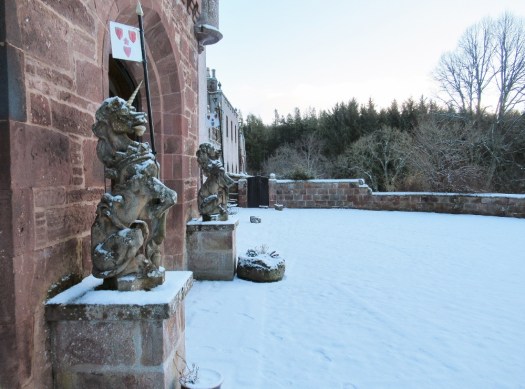
As are unicorns, Scotland’s national animal (yes, really).
Globe thistles, His Majesty’s Theatre in background:
Anemones:
Larger view of the gardens, where wild flowers now abound. Bon Accord!
Sisters at the Edge of the World
From the misty hills of ancient Scotland emerges a tale of love, betrayal, and the fight for freedom.
Set in 1st century Scotland, SISTERS AT THE EDGE OF THE WORLD includes the battle of Mons Graupius between the Romans and the Caledonian tribes. The book features a neurodivergent main character and some rather complicated romance!
Provost Skene’s House nestles between the new buildings and giant plant pots of Aberdeen. This post details a visit from 2023.
It’s been a long time since I’ve visited the 16th century townhouse. In fact, it’s been a very long time since I’ve been in the city centre. In recent years trips to Aberdeen have been illness or hospital related.
There have been a few changes.
Marischal College
The fountains in front of Marischal College are new:
My father worked in the building when I was a child, and there were regular family trips to the Anthropological Museum there. This was later called the Marischal Museum, and it’s no longer open to the public. You can, however, browse online exhibitions.
Provost Skene’s House
Provost Skene’s House door
History
Dating from 1545, the house has been lived in by a variety of people over the centuries. Provost Skene owned it in the 17th century, and Hanoverian troops used it during the Jacobite rebellion of 1745. The Duke of Cumberland stayed there on his way to Culloden. It’s been a museum since 1953. See a more thorough history of the house here.
Museum
The museum used to be set up with rooms furnished in different eras: Edwardian bedrooms and Victorian sitting rooms, that sort of thing. It now houses an exhibition of noteworthy people from Aberdeen, and many of the displays are digitised. I rather miss the harpsichords and harps of the previous arrangement.
The Glass Floor
The glass floor in the cellar is still there, and I’m glad about that. The room was previously a coffee shop, and walking over the floor was a highlight for me as a child. I may not have been frightened when locked in a witch’s hoosie, but this floor scared me in an exhilarating sort of way.
I put the scary floor into the castle of my books. The quote below is from Fouetté, the third and final title of A Dancer’s Journey, and it describes how the glass used to look in Provost Skene’s House.
Eerie green light still shone up from below the glass, showcasing the museum pieces in the floor: barrels, bottles, various metal implements, a cauldron. The glass had been replaced, of course, and part of it given proper hinges, not like back then when…
I had to cut the quote short there, because: spoilers. The floor is no longer lit up.
The Painted Gallery
The highlight of the house for me now is the Painted Gallery. It has not changed, apart from the removal of the Mouseman benches.
The ceiling depicts the life of Christ. Below is the Entombment, with a kilted gentleman standing to the right.
Something else that has not changed is the smell of Provost Skene’s House. It’s quite strong and distinctive. I think it might be caused by the use of some sort of speciality wood preserver or furniture polish.
I walk across the flagstone floor of Provost Skene’s.
And then stroll between the old and the new.
I prefer the old.
The Angry Man
Let’s finish with an angry man. He was originally situated on the wall of a 19th century bakery in the city. It was shut down due to its close proximity to a sewer; the baker blamed his neighbours for the closure, and pointed his angry face at them. He now glares at everyone as they walk past Provost Skene’s House.
SISTERS AT THE EDGE OF THE WORLD
Set in 1st century Scotland, SISTERS AT THE EDGE OF THE WORLD includes the battle of Mons Graupius between the Romans and the Caledonian tribes. The book features a neurodivergent main character and some rather complicated romance…
Go here to sign up for my occasional emails that always include some exclusive photos and news of my writing and life. If you would rather just hear about new books and offers, you can follow my Amazon author page.
Near the village of Pennan, Cullykhan is a place that has long been appreciated by people, so it has a rich history. To the left of the sandy and sheltered beach lies an impressive promontory.
It’s been home to an Iron Age fort, now vitrified, and a medieval castle. Excavations have uncovered Neolithic and Roman finds (read more about these on the Canmore site).
From the promontory, you can see the Deil’s Lum (meaning devil’s chimney). This cave shoots sea spray with a roar during stormy weather.
It’s a place – promontory, bay and caves – that I write about quite a lot.
In THE MERMAID AND THE BEAR, Isobell, Jasper and Ian have to cross the inside of the Deil’s Lum before following a tunnel to the castle. The tunnel is fictional, and so is my description of the interior of the cave, or rather it’s stolen from just around the corner.
As is my way, in the name of research, I have explored every tunnel and cave that is remotely accessible by land at Cullykhan.
This one leads to a dark and seagull-filled space… and it’s this space that I made the characters traverse, after slipping and sliding across it myself, of course.
Isobell, at least, did not enjoy the experience:
The truth was that caves and tunnels were more fun when told of beside a fireside, in dry clothes with a full belly. The reality of them – the cold, the wet, the dripping and the echoing, and the smell of decay – was only startling. The roof looked as if a huge ogre had wielded a knife inside the cliffs, cutting and carving to his heart’s content, but the idea contained no mirth, nor even any interest. And what lay ahead in this new life of ours?
Excerpt from THE MERMAID AND THE BEAR
Climbing to the Cave
Staring at the entrance of the Deil’s Lum from across the divide wasn’t enough for me, so one day I slid down the hill and climbed up into it. This is foolhardy behaviour, and not recommended, but I made a short video so you can see the cave without risking your own life and limb.
Writing Cullykhan
Cullykhan features heavily in the 1st century story of SISTERS AT THE EDGE OF THE WORLD. I loved writing about this beautiful place, capturing the essence of it in words. I took its great magnificence, and its beauty, and swirled them around, adding terrible, strange and unexpected events into the mix.
Set in 1st century Scotland, and featuring the cliffs and caves of Cullykhan Bay, SISTERS AT THE EDGE OF THE WORLD includes the battle of Mons Graupius between the Romans and the Caledonian tribes. The book has a neurodivergent main character and some rather complicated romance…
Go here to sign up for my occasional emails that always include some exclusive photos and news of my writing and life. If you would like to hear about new books and offers, you can follow my Amazon author page.