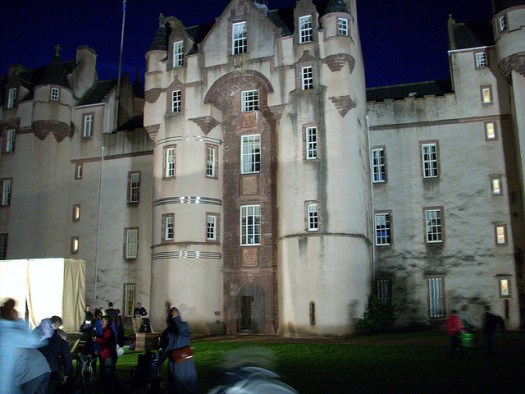
I’ve visited Pitfour Estate many times over the years. It’s a great place to walk, though less well known than the nearby Aden Park. I have photos from various years and various seasons. That’s summer above. Remember summer?
History of Pitfour Estate
The estate was purchased in 1700 by James Ferguson of Badifurrow, who became the first Laird of Pitfour. He and his descendants developed the land, building various bridges and follies. The observatory in Drinnie’s Wood used to be part of the estate too, having been built to watch horse racing on the nearby race track (now a forest).
The Temple of Theseus
One of the follies was a bathhouse built to look like a Temple of Theseus, seen from across the lake below.
The fifth Laird, an extravagant man who liked his luxuries, is said to have kept pet alligators in it. The interior:
Looking out over the lake from behind the pillars of the temple, on another summer’s day:
Pitfour in the Mist
The lake is used by a local fishing club today. You often see jumping fish.
I have a great many pictures, so I intend to share some more of them in my next newsletter: swans, another folly and some more mist. Hopefully that’ll go out in the next few days, if my current writing project releases me for long enough to do it! Go here to sign up for the newsletter.
Mermaid and Fireflies Reviews
Mallee Stanley shared reviews of THE MERMAID AND THE BEAR and FIREFLIES AND CHOCOLATE on her Read and Write blog recently. “”What makes both these books fascinating reads, is that they are based on dark historical events relating to Aberdeen.” See the whole review here.
Hot chocolate. Chocolate cake. Chocolatey books. I love these things. I need them. Especially in winter, and we’re nearly there now. This is the last post of the road to winter series; I’ve finally used up all the pictures!
Some colour clings on, though many trees are bare.
It looks like this wee tree lost all its leaves at once:
FIREFLIES AND CHOCOLATE was inspired by the 600 children and young people who were kidnapped from Aberdeen during the 1740s and sold into indentured servitude in the American Colonies. The story follows the adventures of Elizabeth Manteith from the castle and her determined efforts to get back home. There’s love. There’s proper derring-dos on the high seas… And there’s chocolate!
I was really delighted when I learned that the publisher had used an image of a real 18th century chocolate cup on the cover.
Enjoy a kiss on the London tube in TENDU. Eat chocolate cake in Covent Garden and Scotland. Romp up and down the castle stairs! Dance in a stone circle. Attend a Ceilidh in the great hall. Have your brain studied in the dungeon. All fun, I assure you. Well, not quite all…
“If you enjoy mentions of chocolate and lots of cake, this book is for you.”From a recent review.
Keep up to date with all my news, chocolatey and otherwise, by signing up to the mailing list. It’s a more intimate space than the blog and always contains some exclusive photos. If you would like to hear about new books and offers, you can follow my Amazon author page.
But, for now, this morning, I’m off back into the manuscript of the moment. I’m working on the first title in the next book series, Castle Dancers. It begins ten years after TENDU – each book has a different main character – and the story starts like this:
It’s the night before I’m due to start at the most prestigious dance school in Scotland, so, of course, my mother tries to kill me.
Fun times!
TENDU: Dancing in the Castle
Dance, danger and desire collide in TENDU, a seductive tale set in the mystical landscape of Scotland. Will love conquer all?
Go here to sign up for occasional emails that always include exclusive photos and news of my writing and life. They’re a bit more intimate than the blog. If you would like to hear about new books and special offers, you can follow my Amazon author page.
I took a quiet walk through autumn leaves at Aden Park.
Peering through an old tree:
Up by the Mansion House:
Blue and green should most definitely be seen…
Some of the newer plantings have not survived:
But many have:
I love the Maples.
I feel like I don’t have many words left in me. They’ve been used up. They’re coming very soon in book form.
Newsletter
Keep up to date with all my news, leafy and otherwise, by signing up to the mailing list. It’s a more intimate space than the blog and always contains some exclusive photos. If you would like to hear about new books and offers, you can follow my Amazon author page.
These days, you don’t have to catch a boat or ferry and can drive straight over the large Skye bridge. That’s the Old Man of Storr in the hills above, a beautiful rock formation visible for miles around. This post details a holiday I took with my family in 2017, before chronic illness put paid to such things as holidays. For now. I have to believe, for now. But enough of that, over the sea to Skye we go!
Dun Hallin
The island is a place of fairies: there’s a castle and a glen and a bridge, much smaller than the one taken to get to the island. But first, back to another rock formation, specifically the one spied from the bedroom window of our holiday house.
‘That’s an interesting rocky outcrop,’ said I to husband.
‘Aye, we should walk up to it,’ he replied.
So we did.
And there was Dun Hallin, an Iron Age broch we had intended visiting but thought would be hard to find. Duns, or brochs, were a complex form of roundhouse, probably defensive, precursors to castles.
I loved Dun Hallin and the surprise of finding it like that. And the wonderful views of Trumpan Point.
The Trial Stone
Trumpan Kirkyard held surprise too. An ancient standing stone, Clach Deuchainn, the Trial Stone:
Trial stones were used to try a person. In this case if the accused could put their finger in the hole located on the stone, while blindfold, they were innocent. The stone is undoubtedly far older than this use. It is also known as the Priest Stone and the Heaven Stone.
There were some interesting graves too; these, and the gruesome history of the church can be read about here.
Fairies
But back to the fairies. Firstly the Fairy Glen, an unusual land formation, which sadly does not have anyfolklore associated with it, but it does feel otherworldly when you walk round it.
The rocky peak is known as Castle Ewen:
It’s Dunvegan Castle that we need for fairy legends!
Displayed inside the castle, so no photos, is the ancient and tattered Fairy Flag. There are many stories and traditions surrounding this relic and its origins. The tale favoured in the information provided to visitors is the one in which the Chief of Clan Macleod marries a fairy. The couple have a child together but the fairy knows she has to return to her people in Fairyland. She leaves the magical flag, imbued with protective powers, wrapped round the baby, and this she does a few miles away at the Fairy Bridge:
There are also Fairy Pools on Skye but we did not get to them this trip. We did manage a quick visit to Kilt Rock:
We also took in the Museum of Island Life, one of the few places on the island with good mobile internet which meant I was distracted by a sudden barrage of Twitter notifications!
Near to the museum is the memorial to Flora MacDonald:
One more fairy mention: the house we stayed in was previously owned by the writer Aileen P. Roberts, and full of books, so I read her novella Fairy Fire while there, which was set in Skye and surprising and perfect.
The sun rises over Dun Hallin:
And sets at Trumpan Point:
We’ll be back over the sea to Skye again one day!
Newsletter
Go here to sign up for my (roughly monthly) newsletter. It’s a more intimate space than the blog and always includes some exclusive photos. If you would rather just hear about new books and offers, you can follow my Amazon author page.
My Books
Set in 1st century Scotland, my latest novel, SISTERS AT THE EDGE OF THE WORLD, includes the battle of Mons Graupius between the Romans and the Caledonian tribes. The book features a neurodivergent main character and some rather complicated romance!
Taking place mainly in a fictional castle, THE MERMAID AND THE BEAR blends an often overlooked period of history, the Scottish witchcraft accusations, in particular the 1597 Aberdeen witchcraft panic, with a love story.
FIREFLIES AND CHOCOLATE was inspired by the kidnapped children and young people of Aberdeen. The story follows the adventures of Elizabeth Manteith from the castle and her determined efforts to get back home. There’s love. There’s derring-dos on the high seas… And there’s chocolate!
A couple of miles from the town of Forres in Moray is a mound known as Macbeth’s Hillock. Local folklore tells us that this is where Macbeth met with the three witches from the play.
‘By the pricking of my thumbs, Something wicked this way comes.’ So pronounces the second witch in Macbeth, Act 4, scene 1.
The Three Witches
The theme of the three witches is echoed in more folklore from the surrounding area. There are two stones in Forres that are both associated with them.
The Sueno’s Stone
In its glass case
This is a 9th-10th century Picto-Scottish stone depicting an ancient battle (I like to think it’s Mons Graupius as featured in SISTERS AT THE EDGE OF THE WORLD, but this is very unlikely given how long ago that battle took place). The stone is 6.5 metres tall and also lays claim, in local legend, to be situated where Macbeth met the witches. They are said to have been captured inside the stone, and should it ever be broken, they will be released.
Battle sideCeltic Cross side
The Witches Stone
A rather more gruesome stone, and story, sits outside the police station on the main road in Forres. It has become a small shrine.
There were originally meant to be have been three stones marking the final resting places of three women who were executed for witchcraft. The one remaining stone is held together with a piece of metal.
Go here to sign up for occasional emails that always include some exclusive photos and news of my writing and life. They’re a more intimate space than the blog. If you would rather just hear about new books and offers, you can follow my Amazon author page.
This was the first time I’d ever been in this circle. It’s right beside farm buildings, and you have to ask permission to walk through the farmyard to the stones. There’s a great farm shop, so I shopped for local tatties and asked in there.
The circle had a wall and fence round it. No gate. I hoisted myself over these barricades and into the wilderness that surrounds the stones. It was rather lovely. Muted light. Pink granite everywhere. Trees that seemed to be the same colour as the stones.
The Bear
I noticed that one of the photos I’d taken had that paw print icon, indicating that Siri had spotted an animal. Thinking I’d maybe missed a farm cat, I clicked on it.
It looks like there may have been a few cases of mistaken identity!
Go here to sign up for my occasional emails that always include some exclusive photos and news of my writing and life. If you would like to hear about new books and offers, you can follow my Amazon author page.
I walked across the stubbly field to Inverallochy Castle at the weekend. It’s one of the nine castles of the knuckle, a term coined by historian William Douglas Simpson. It refers to nine ancient castles built along the rocky (knuckle-like) coast of Buchan in NE Scotland. I’ve been to most of them, so here we go!
Close-up of Inverallochy, a Comyn family castle, dating from 1504:
Apparently there used to be a stone above the door stating that the land around the castle “was obtained by Jordan Comyn for building the abbey of Deer.” Deer Abbey and its older site are some miles away – I wrote about the Abbey here – so that’s a little odd. Maybe ancient plans changed, or the inscription was incorrect. The stone disappeared in the 18th century.
Medieval re enactor and ‘Man at Arms’ Andrew Spratt made this GIF showing how the castle used to look:
We’re going to head north from Inverallochy. There were two knuckle castles south of here – Lonmay and Rattray – but they have crumbled away to nothing. I have written about the ancient chapel at Rattray, and its pirate steps, here.
Cairnbulg Castle
Next up the coast is Cairnbulg Castle, one of the oldest buildings in Aberdeenshire still to be inhabited by the family that built it. It’s home to Lady Saltoun, Chief of the name and arms of Fraser.
The Wine Tower
Not actually a castle, but one of the nine anyway, the Wine Tower in Fraserburgh is a post-reformation Catholic chapel. See my post here
On we go to Pittulie Castle, thought to date from 1596, the year that my novel The Mermaid and the Bear begins, so I have an extra fondness for this castle. In the 18th century the owner was friends with the lovely Lord Pitsligo who lived next door.
Pitsligo Castle
This castle started out as a keep (the high part on the right above) in 1424 but expanded greatly over the centuries. See my post on it here.
Dundarg Castle
Sadly, I have no photos of the last of the nine castles of the knuckle, Dundarg, as it’s on private land right by a house. It sits on a promontory within the ramparts of an Iron Age fort. It’s referenced from the 10th century, though only the gatehouse remains today.
The Mermaid and the Bear
Lost in ancient woodlands and caught up in whispers of witchcraft, Isobell must navigate danger to reclaim her life. Can she find her happily ever after?
Set in a fictional castle in Aberdeenshire, Ailish Sinclair’s debut novel, THE MERMAID AND THE BEAR, blends an often overlooked period of history, the Scottish witchcraft accusations, in particular the 1597 Aberdeen witchcraft panic, with a love story.
That’s definitely not the real Stone of Scone above. It’s an ancient standing stone at Finlaggan on the Isle of Islay.
But is the official stone, the one pictured below, the real stone? See BBC article about this stone as it heads south to be used in the latest coronation.
History of the Real Stone of Scone
The Stone of Scone, or Stone of Destiny, was used in the inauguration of Scottish Kings for centuries. In 1296 the English King, Edward I, took the stone from Scotland and incorporated it as part of his new ‘Coronation Chair’. Or did he?
Fobbed Off and Spirited Off?
Early mentions of the stone describe it as black and shiny, polished and beautiful. It’s rumoured that Edward was fobbed off with a worthless rock that was actually a drain cover, while the real stone was spirited off and hidden safely away.
Finlaggan is a quiet and remote place. It’s easy to believe that it might hide secrets.
An archaeological dig there was abandoned when money ran out.
If the stone is at Finlaggan, I suspect it might be on the Council Island, the place of important discussions and decisions. Maybe the island was also the site of a few laughs about kingly bottoms sitting over what was actually a drain plug?
“In the vein of Lucy Holland’s Sistersong with the narrative style of Rena Rossner’s The Sisters of the Winter Wood, Sinclair’s novel centers on two sisters and is told from Morragh’s point of view. The prose is deeply personal to Morragh’s struggles.”
Sign up to the mailing list for news about my life and writing, and some exclusive photos. If you would rather just hear about new books and offers, you can follow my Amazon author page.
As a child, the task of walking to the 18th century Bridge of Alvah, near Banff in Aberdeenshire, was presented as something akin to travelling to Mordor: a journey of such length and difficulty as to render it impossible to your average mortal.
The walk from Duff House (a place with easy parking, swings, art gallery, tearoom and gift shop) to Alvah is actually comprised of just over two miles of well maintained track.
The other fact about Alvah recalled from childhood is that it is a place of great natural beauty. That is true.
The bridge stands huge and majestic – it is a bit ‘Lord of the Rings’ after all – over a deep gorge and the River Deveron.
A Mystery Window
I was most intrigued by the Gothic window and the many little hooks, just about discernible below.
The Naughty Earl
Googling revealed that there was a room for a toll collector within the bridge. This explains the window, though how a person got in there is not so clear. Either the door has been sealed or there was something Rapunzel-like going on. Local legend has it that the room was used by a (married) Earl to entertain young ladies, so perhaps it was kept semi-secret. The Earl’s wife reportedly shot him.
The hooks remain a mystery.
In summary: go visit the Bridge of Alvah; it’s well worth the two mile trek. Not an orc in sight!
See the post about the Mausoleum for more on the grounds of Duff House.
The Secret Room Update
We revisited the bridge in autumn and were given permission to access the Earl’s secret room/love nest. This involved a somewhat steep and scary climb down the bank of the river.
It was worth it. The room is beautiful.
Naughty Dancers Instead of Earls
Scotland’s all misty lochs and magical forests and perfect boyfriends, right?
When dance student Amalphia Treadwell embarks on a secret relationship with her rich, handsome teacher, she has no idea of the danger that lurks in his new school in Scotland…
My dance background and love of history and spicy stories are what inspired this heady mix of contemporary romance and ballet set in a castle. Readers of my historical fiction will recognise the castle and stone circle that feature in these books.
There are no cliffhanger endings in this series; each book completes a story, but then there is more. So much more. Read all the blurbs here
Go here to sign up for my (roughly monthly) newsletter. It’s a more intimate space than the blog and always includes some exclusive photos. If you would like to hear about new books and offers, you can follow my Amazon author page.